
Stopping Vyvanse suddenly at a prescribed therapeutic dose is generally medically safe — clinical trial data confirms that abrupt discontinuation was not associated with significant amphetamine withdrawal symptoms What happens if you stop taking Vyvanse suddenly. However, most people experience a rebound period of fatigue, low mood, increased appetite, and a sharp return of ADHD symptoms. The intensity and duration of this depends heavily on how long you’ve been taking it, at what dose, and whether use was therapeutic or above prescribed amounts.
Why People Stop Vyvanse Suddenly — and Why It Matters
People stop Vyvanse abruptly for many reasons: running out of a prescription, deciding the medication isn’t working, concerns about long-term use, pregnancy, supply issues, or simply choosing to come off it. Whatever the reason, understanding what your body and brain will go through — and how to manage it — makes the process significantly easier.
There’s also an important distinction worth making upfront: the experience of stopping Vyvanse is very different depending on whether you’ve been taking it at a prescribed therapeutic dose or above it. This article covers both, because the honest picture requires both.
What You Need to Know First
Vyvanse (lisdexamfetamine dimesylate) works by converting into dextroamphetamine in your red blood cells, increasing dopamine and norepinephrine activity in the prefrontal cortex. When you stop taking it, your brain has to readjust to producing and managing these neurotransmitters without the daily stimulant input it has adapted to. This adjustment — not a toxin leaving the body — is what produces the symptoms people associate with “withdrawal” from Vyvanse.
Critically: returning ADHD symptoms after stopping Vyvanse are not withdrawal — they are the underlying condition re-emerging. Clinicians flag this distinction as one of the most important for patients to understand, because misidentifying symptom recurrence as withdrawal can lead to unnecessary distress or inappropriate treatment decisions.
Quick Overview: Stopping Vyvanse
- Medically dangerous to stop suddenly? No — at therapeutic doses
- Will you feel it? Almost certainly — for 1–7 days for most prescribed users
- Withdrawal vs. symptom recurrence: Distinct — one is neurochemical adjustment, one is untreated ADHD
- Tapering required? Not clinically required at therapeutic doses; may be helpful psychologically
- Prescribed users: Typically recover within 1–2 weeks; mild to moderate symptoms
- High-dose or misuse context: More significant symptoms; medical support recommended
- Safe to restart after stopping? Yes — same previous dose, no re-titration required after short breaks
The Difference Between a Crash, Rebound, and Withdrawal
These three terms describe different experiences that are often confused — understanding which one applies to your situation shapes how you respond:
The Daily Crash:
The Vyvanse crash happens every day as the medication wears off — typically 10–14 hours after dosing. It’s not withdrawal; it’s the natural end of the dose cycle. Symptoms include fatigue, mild irritability, low mood, and increased appetite as dextroamphetamine levels drop. This happens even when you’re taking the medication correctly and consistently.
Rebound:
Rebound is a sharper, more intense version of the crash — when ADHD symptoms return more intensely than baseline as medication drops off. This typically lasts around an hour and is more pronounced when the dose is too low or clears too quickly. It’s dose-related, not withdrawal-related.
Actual Withdrawal:
Withdrawal refers to a neurochemical adjustment period that begins after your last dose and continues for days to weeks as the brain recalibrates. Unlike crash or rebound, withdrawal doesn’t resolve within hours — it persists and evolves. It is most significant in people who have been taking Vyvanse at higher-than-prescribed doses for extended periods.
What Actually Happens When You Stop at a Prescribed Dose
This is the scenario most Australian Vyvanse patients face, and the picture here is more reassuring than many expect.
Clinical trial data on lisdexamfetamine discontinuation — including studies covering 12 weeks and 38 weeks of use — found that abrupt cessation was not associated with clinically significant amphetamine withdrawal symptoms at therapeutic doses. Withdrawal scores in the Vyvanse group were comparable to placebo at discontinuation, even after extended use.
The FDA label for Vyvanse does not include tapering requirements or specific withdrawal warnings for therapeutic dose discontinuation. Stimulant medications have fundamentally different dependence and withdrawal profiles from substances like opioids or alcohol — a distinction that matters for appropriate patient counselling.
What most prescribed patients do experience when stopping:
- A pronounced fatigue and tiredness — particularly on days 1–3 — as the brain adjusts to its natural dopamine baseline
- Increased appetite and food cravings, sometimes significant, as appetite suppression from the medication lifts
- Low mood or mild depression — a dip in motivation and emotional tone as dopaminergic stimulation is removed
- Difficulty concentrating — this is the underlying ADHD returning, not withdrawal per se
- Disrupted sleep — either sleeping more than usual (hypersomnia) or experiencing vivid/unusual dreams as the brain recalibrates
- Irritability and mild anxiety in the first few days
- A general feeling of mental heaviness or slowing compared to the medicated state
For most prescribed patients taking therapeutic doses, the most intense symptoms are in days 1–4, and the majority of adjustment is complete within 1–2 weeks.
The Withdrawal Timeline: What to Expect Day by Day
The timeline varies by individual, dose level, and duration of use, but this reflects the typical pattern for therapeutic-dose users:
Day 1 (Last dose day and into the evening):
The daily crash arrives as normal. As the medication fully clears, fatigue and low motivation set in more heavily than a usual evening.
Days 1–3 (Acute phase):
The most pronounced adjustment period. Expect significant fatigue, increased appetite (often intense food cravings), low mood, difficulty initiating tasks, and hypersomnia — sleeping longer than usual but not feeling rested. ADHD symptoms return at or above pre-medication baseline.
Days 4–7:
Symptoms begin to stabilise for most therapeutic-dose users. The sharpest fatigue and mood dip typically eases. Appetite normalises. Sleep quality often improves. The full return of ADHD symptoms — poor focus, impulsivity — remains, but the neurochemical adjustment piece starts to settle.
Week 2 and beyond:
For most prescribed patients, the adjustment is largely complete within two weeks. What remains after this point is not withdrawal — it is the underlying ADHD, unmanaged. Some patients report a few weeks of emotional flatness or low motivation before their baseline dopamine production fully normalises.
For high-dose or extended misuse contexts:
More prolonged and potentially more severe symptoms — including significant depression, mood swings, craving cycles, and in rare cases, symptoms requiring clinical support — can extend for weeks to months. Medical guidance is recommended for these situations.
- What happens if you stop taking Vyvanse suddenly Hobart
- What happens if you stop taking Vyvanse suddenly Devonport
- What happens if you stop taking Vyvanse suddenly Launceston
- What happens if you stop taking Vyvanse suddenly Tasmania
- What happens if you stop taking Vyvanse suddenly Victoria
- What happens if you stop taking Vyvanse suddenly Queensland
- What happens if you stop taking Vyvanse suddenly Canberra
- What happens if you stop taking Vyvanse suddenly Australian Capital Territory
- What happens if you stop taking Vyvanse suddenly South Australia
- What happens if you stop taking Vyvanse suddenly New South Wales
- What happens if you stop taking Vyvanse suddenly Darwin
- What happens if you stop taking Vyvanse suddenly Ghan
- What happens if you stop taking Vyvanse suddenly Northern Territory
- What happens if you stop taking Vyvanse suddenly Australia
- What happens if you stop taking Vyvanse suddenly Austria
- What happens if you stop taking Vyvanse suddenly Germany
- What happens if you stop taking Vyvanse suddenly United Kingdom
- What happens if you stop taking Vyvanse suddenly Sweden
- What happens if you stop taking Vyvanse suddenly Denmark
- What happens if you stop taking Vyvanse suddenly Norway
- What happens if you stop taking Vyvanse suddenly Finland
- What happens if you stop taking Vyvanse suddenly Iceland
- What happens if you stop taking Vyvanse suddenly Netherlands
- What happens if you stop taking Vyvanse suddenly Spain
- What happens if you stop taking Vyvanse suddenly Ireland
- What happens if you stop taking Vyvanse suddenly Switzerland
Stopping Vyvanse for Binge Eating Disorder: A Different Consideration
For Australian adults using Vyvanse specifically for binge eating disorder (BED), stopping suddenly carries additional clinical complexity. Vyvanse for BED works by consistently modulating dopamine reward circuits that drive binge behaviour. Abrupt discontinuation removes this protection immediately, significantly increasing the risk of a binge episode in the first days after stopping.
If you are stopping Vyvanse for BED, this should be a planned, supervised process involving your prescribing doctor and, ideally, a therapist or eating disorder specialist — not a sudden unilateral decision.
Do You Need to Taper Off Vyvanse?
For therapeutic-dose prescribed users, tapering is not clinically required. The FDA label does not mandate tapering, and clinical data does not support a significant physiological withdrawal syndrome at prescribed doses that would necessitate gradual reduction.
However, there are legitimate reasons a prescriber might suggest a taper in certain patients:
- Patients who have been on Vyvanse for several years at higher doses and have significant psychological dependence on the medication’s effects
- Individuals with underlying anxiety or mood disorders where the adjustment period needs to be managed gradually
- Patients stopping Vyvanse for BED, where gradual reduction may be preferred to avoid immediate behavioural relapse
For most straightforward cases of stopping a therapeutic prescription, simply stopping is pharmacologically appropriate. A prescriber-guided conversation is still strongly recommended — not because tapering is medically required, but because your prescriber should know you’re stopping, and can provide guidance for the adjustment period.
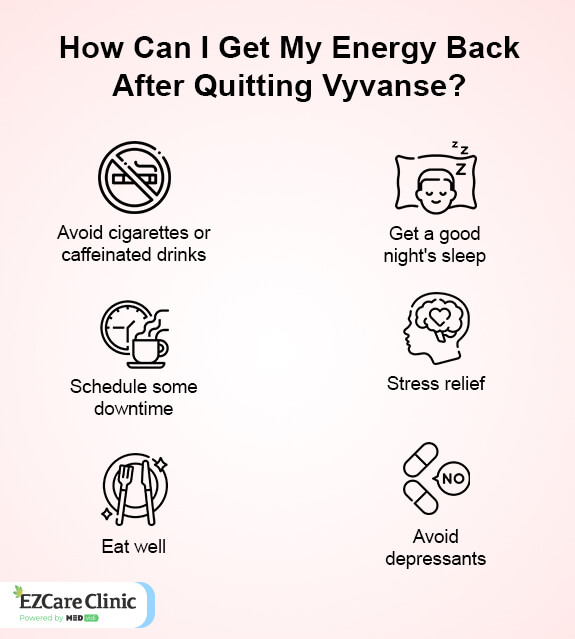
How to Manage the Adjustment Period Comfortably
If you’re stopping Vyvanse — whether for a break, a medication review, or permanently — these strategies support a smoother transition:
- Plan your stop during a low-demand period — a week where work or school pressure is lower gives you room to function through the fatigue and reduced focus of days 1–5
- Prioritise sleep — aim for 8–9 hours and don’t fight hypersomnia in the first few days; this is your brain recovering
- Eat balanced, protein-rich meals — blood sugar stability reduces mood dips and supports dopamine precursor availability
- Exercise lightly — gentle walking or moderate activity supports dopamine and norepinephrine production naturally and can meaningfully ease the mood dip of the adjustment period
- Avoid alcohol entirely during the adjustment period — it compounds depression, disrupts sleep architecture, and prolongs neurochemical normalisation
- Reduce cognitive demands for the first week — this is not the time to take on your most complex projects or decisions; your executive function is genuinely reduced
- Tell someone you trust that you’re stopping — having a close friend, partner, or family member aware of what you’re going through provides both accountability and practical support
When Stopping Vyvanse Requires Medical Support
While most prescribed Vyvanse users can stop safely without medical intervention, certain situations warrant professional support:
- Significant depression or suicidal thoughts during the adjustment period — dopamine withdrawal can trigger or worsen depressive episodes, and this should be monitored
- History of substance use disorder — stopping any stimulant in the context of a broader addiction history needs supervised support
- High-dose or above-prescription use — the adjustment from supratherapeutic doses is meaningfully different and may require medical oversight
- Co-occurring mental health conditions — if you have anxiety, bipolar disorder, or major depression, the mood impacts of stopping Vyvanse may need to be managed concurrently
- Vyvanse for BED — stopping without a plan significantly increases relapse risk
In Australia, your prescribing psychiatrist or GP is the first point of contact. For urgent support during an adjustment period, the Beyond Blue support line (1300 22 4636) and Lifeline (13 11 14) are available 24/7.
Safety and Important Considerations for Australian Adults
- Vyvanse is Schedule 8 in Australia — if you stop taking it and later want to restart, you’ll need an appointment with your authorised prescriber. Your prescription cannot simply be “paused and resumed” by a pharmacist without prescriber involvement
- Do not drive or operate machinery during the acute adjustment phase (days 1–5) if your ADHD symptoms significantly impair attention and reaction time — this is a genuine road safety consideration
- The TGA’s consumer medicine information for Vyvanse does not include a tapering requirement but does advise patients to consult their doctor before stopping
- Restarting after a short break (days to a few weeks) does not require re-titration — most patients can return to their previous prescribed dose safely
Common Misconceptions About Stopping Vyvanse
Myth 1: “You’ll go through severe withdrawal like opioids or alcohol.”
This comparison is inaccurate and unnecessarily frightening. The withdrawal profiles of opioids and alcohol are fundamentally different from stimulant medications — they involve distinct neurochemical systems and carry different medical risks. Vyvanse discontinuation at therapeutic doses does not carry the medical danger of opioid or alcohol withdrawal and does not require hospitalisation or medical detox in most cases.
Myth 2: “The fatigue and depression mean Vyvanse was treating depression all along.”
The low mood and fatigue that follow stopping Vyvanse are the result of neurochemical adjustment — the brain recalibrating to its natural dopamine baseline after sustained stimulant support. This is not evidence that you have a depressive disorder. For most people, these feelings resolve within 1–2 weeks.
Myth 3: “I need to taper slowly over months.”
Tapering is not clinically mandated for therapeutic-dose users of Vyvanse. Clinical trial evidence supports the safety of abrupt cessation at standard doses. While a gradual reduction is not harmful if that’s your preference, an extended multi-month taper from a therapeutic dose is more than the pharmacology requires.
FAQ: People Also Ask About Stopping Vyvanse Suddenly
Is it safe to stop taking Vyvanse cold turkey?
For most people taking Vyvanse at a prescribed therapeutic dose, yes — stopping abruptly is medically safe. Clinical studies on lisdexamfetamine found that abrupt discontinuation was not associated with clinically significant withdrawal symptoms at therapeutic doses. You will likely experience a rebound and adjustment period, but this is not medically dangerous in most cases.
How long do Vyvanse withdrawal symptoms last?
For prescribed therapeutic-dose users, the most intense adjustment symptoms typically last 3–7 days, with most symptoms resolving within 1–2 weeks. The timeline is longer and more variable for people who have used Vyvanse above therapeutic doses or for extended periods at higher doses, where symptoms can persist for weeks.
What does Vyvanse withdrawal feel like?
The most commonly reported experiences include extreme fatigue (particularly in the first 2–3 days), low mood or mild depression, intense food cravings, increased sleep, difficulty concentrating, irritability, and a sharp return of ADHD symptoms. For most therapeutic-dose patients, it is uncomfortable but manageable — not medically dangerous.
Will my ADHD symptoms come back when I stop Vyvanse?
Yes — your ADHD symptoms will return when you stop Vyvanse, because the medication was managing them, not curing the underlying condition. This is symptom recurrence, not withdrawal. How impairing this is depends on your baseline severity and what other strategies — behavioural, environmental, therapeutic — you have in place.
Do you need to taper Vyvanse before stopping?
No — clinical evidence and the FDA label for Vyvanse do not require tapering at therapeutic doses. You can stop abruptly if you and your prescriber decide that’s appropriate. A taper may be preferred in specific circumstances — such as high-dose use, BED treatment, or co-occurring mood disorders — but it is not pharmacologically required for standard prescribed users.
Can you restart Vyvanse after stopping?
Yes — restarting Vyvanse after a break does not require re-titration from 30 mg if you’ve been off it for a short period (days to a few weeks). You can generally return to your previously prescribed dose under the guidance of your authorised prescriber. If you’ve been off Vyvanse for an extended period or your situation has changed significantly, your prescriber may prefer a formal review first.
What should I do if I feel severely depressed after stopping Vyvanse?
Mild to moderate low mood is expected in the adjustment period and typically resolves within 1–2 weeks. If you experience severe depression, hopelessness, or thoughts of self-harm, contact your prescribing doctor immediately. In Australia, you can also call Lifeline on 13 11 14(24/7) or Beyond Blue on 1300 22 4636 for immediate support. This is not a normal part of adjustment from therapeutic doses — it requires professional attention.
