
How Long Does Vyvanse Peak Last in 2026?
Vyvanse reaches its peak effect approximately 3.5 to 5 hours after ingestion, with the peak window — where focus, clarity, and symptom control are at their strongest — lasting roughly 2 to 4 hours before transitioning into a sustained therapeutic plateau. The total duration of therapeutic effects spans 10 to 14 hours depending on dose, metabolism, and whether it was taken with food. The peak is not a sharp spike like immediate-release stimulants — it is a smooth, gradual arc that rises, sustains, and tapers.
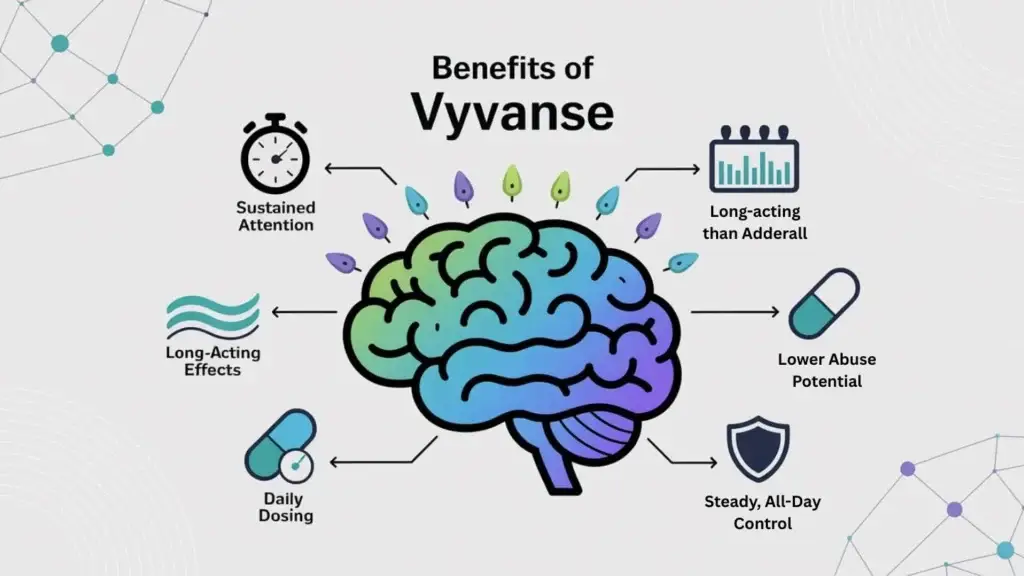
Why This Matters
Understanding when Vyvanse peaks — and how long that peak lasts — gives you direct control over your productive hours. Patients who know their peak window can schedule their most cognitively demanding work, important meetings, or high-focus tasks to align with maximum medication effectiveness. Patients who don’t can find themselves doing deep work when the medication is ramping up or winding down, then wondering why it “isn’t working.” The timing is predictable — but only if you know what to look for.
What You Need to Know First
Vyvanse’s peak profile is fundamentally different from other ADHD stimulants because of its prodrug design. Unlike immediate-release dexamphetamine or Adderall — which are pharmacologically active on ingestion and produce a rapid, pronounced peak within 60–90 minutes — Vyvanse must be converted from its inert prodrug form (lisdexamfetamine) into active dextroamphetamine by enzymes in red blood cells. This conversion is biologically rate-limited: it cannot be rushed, and it cannot produce a sudden flood of dextroamphetamine regardless of dose.
The result is a pharmacokinetic profile that looks less like a sharp mountain peak and more like a gently rolling hill — a gradual ascent from onset, a sustained elevated plateau, and a slow, tapered descent. This is why patients transitioning from other stimulants to Vyvanse often describe it as “smoother” — the peak itself is less intense and lasts longer than what they experienced before.
Quick Answer Overview
- Onset: 1–2 hours after ingestion
- Peak begins: ~3–3.5 hours after ingestion
- Full peak: 3.5–5 hours after ingestion
- Peak window duration: Approximately 2–4 hours of maximum effect
- Sustained therapeutic plateau: Hours 6–10 after ingestion
- Wearing off: Hours 10–14
- Total duration: 10–14 hours depending on dose
- Half-life of dextroamphetamine: ~12 hours (affects detection, not therapeutic window)
The Full Vyvanse Timeline: Hour by Hour
Here is what the average Vyvanse day looks like, assuming a morning dose taken without food:
The distinction between “peak” and “plateau” is clinically important. Many patients describe the peak window (hours 3.5–5) as their sharpest cognitive state — the clearest, most organised, most “on” they feel. The plateau (hours 5–10) is less intense but still fully therapeutic — this is the productive working period that makes Vyvanse a strong choice for a full work or school day.
How the Peak Varies by Dose
Dose affects both the intensity and duration of the Vyvanse peak — but not in a simple linear way:
- Lower doses (20–30 mg): A gentler peak that arrives within the 3–4 hour window; plateau sustains for 6–10 hours total. Some patients find lower doses provide adequate coverage without the sharp peak intensity.
- Moderate doses (40–50 mg): A well-defined peak at 3.5–5 hours; strong sustained plateau through hours 5–10; total duration typically 10–12 hours. This is the most commonly prescribed range.
- Higher doses (60–70 mg): The peak is more pronounced and may feel more intense; total duration extends to 12–14 hours. Higher doses tend to intensify the peak experience rather than simply extending the overall duration.
The key clinical nuance: higher doses do not produce a faster-arriving peak — the conversion rate in red blood cells is fixed regardless of dose. What higher doses do is produce more active dextroamphetamine overall, which is perceived as a stronger and longer-lasting peak and plateau.
How long does Vyvanse peak last Hobart
How long does Vyvanse peak last Devonport
How long does Vyvanse peak last Launceston
How long does Vyvanse peak last Tasmania
How long does Vyvanse peak last Victoria
How long does Vyvanse peak last Queensland
How long does Vyvanse peak last Canberra
How long does Vyvanse peak last Australian Capital Territory
How long does Vyvanse peak last South Australia
How long does Vyvanse peak last Western Australia
How long does Vyvanse peak last New South Wales
How long does Vyvanse peak last Darwin
How long does Vyvanse peak last Ghan
How long does Vyvanse peak last Northern Territory
What the Peak Actually Feels Like
During the peak window — approximately hours 3.5 to 5 — patients with ADHD typically report:
- Heightened focus and concentration — the ability to stay on a single task without mental wandering
- Reduced impulsive behaviour — less reactive decision-making, fewer interruptions, greater patience
- Mental clarity and working memory improvement — thoughts feel more organised, less chaotic
- Increased motivation and task initiation — lower internal resistance to starting difficult tasks
- Emotional regulation — a calmer, less reactive emotional baseline
- Reduced hyperactivity — in hyperactive/combined presentations, physical restlessness decreases noticeably
One important clarification: the Vyvanse peak does not feel like a “stimulant rush” in ADHD patients. Because the medication is correcting a neurochemical deficit, the peak experience is typically described as feeling more normal — more like a neurotypical baseline — rather than feeling heightened or euphoric. Patients who describe Vyvanse as feeling “too strong” at peak are typically over-dosed or caffeine-stacking.
Factors That Affect Peak Timing and Duration
Several individual and situational variables shift the peak window earlier or later — and affect how long it is sustained:
Food intake:
Taking Vyvanse with a high-fat meal delays absorption from the gut, pushing peak onset back by approximately 1 hour. A high-fat breakfast may shift the peak from 3.5 hours to 4.5–5 hours. Total duration and total active drug remain the same — only the timing shifts.
Metabolism rate:
Patients with faster metabolic rates convert and clear dextroamphetamine more quickly, producing a shorter, slightly earlier peak. Slower metabolisers experience a more gradual peak with longer tail.
Urinary pH:
Acidic urine (from vitamin C, citrus juices, or high-protein diets) accelerates renal excretion of dextroamphetamine, effectively shortening the active window and compressing the plateau. Alkaline urine does the opposite — extending duration. This is not a dose-management strategy; it is a variable to be aware of.
Age:
Children typically process medications faster than adults, which can mean a slightly earlier and shorter peak. Elderly patients may experience an extended peak window due to slower clearance rates.
Body composition and hydration:
Hydration supports normal red blood cell enzyme function and efficient drug distribution. Significant dehydration is not a clinically common variable, but acute dehydration may blunt peak intensity.
Dose consistency:
Patients who take Vyvanse at the same time daily report more predictable peak timing than those who dose erratically, as physiological rhythms influence absorption and conversion efficiency.
Why the Vyvanse Peak Is Smoother Than Other Stimulants
The peak profile of Vyvanse is pharmacokinetically distinct from every other amphetamine-class medication — and this distinction has direct quality-of-life implications:
Adderall XR uses a dual-bead release mechanism: 50% of the dose is released immediately on ingestion, and 50% is released 4 hours later. This creates a recognisable dual-peak pattern — a first peak at roughly 1–2 hours, a partial trough, then a second peak at 4–6 hours. Many patients feel the transition between these peaks as an energy dip or mood fluctuation.
Dexamphetamine IR peaks rapidly — within 60–90 minutes of ingestion — producing the sharpest and most intense peak of any common ADHD medication. This intensity is exactly what produces the pronounced “crash” that short-acting medications are known for.
Vyvanse, by contrast, has a single, biologically governed peak that rises gradually and sustains for several hours before tapering. There is no second-peak fluctuation as in Adderall XR, and no sharp drop as in IR medications. The enzymatic rate-limiting of dextroamphetamine release is the mechanism — and it cannot be circumvented.
How to Align Your Day With the Vyvanse Peak
Understanding peak timing enables practical daily planning:
- Dose at the same time every morning — consistency in dosing time produces consistency in peak timing; most patients find 6:30–7:30 AM optimal for a 9 AM–5 PM productive window
- Schedule your most demanding work during the peak — hours 3.5–5 after dosing are your sharpest cognitive window; reserve deep work, complex writing, strategic planning, or high-stakes meetings for this period
- Use the plateau for sustained-but-lighter work — hours 5–10 are reliably productive but less peak-intense; administrative tasks, meetings, and collaborative work fit well here
- Don’t fight the taper — reducing cognitive demands as the medication winds down (hours 10–14) rather than fighting fatigue produces a smoother end of day
- Avoid late dosing — because the peak arrives 3.5–5 hours post-ingestion, dosing after 9 AM risks placing the peak in the early afternoon and the active window into the evening, disrupting sleep onset
- Watch the food timing — if you need your peak earlier, take Vyvanse before eating rather than with a heavy meal; if you need to delay it (e.g., for an afternoon focus window), a substantial breakfast immediately after dosing can push it back
Common Misconceptions About the Vyvanse Peak
Myth 1: “The Vyvanse peak is when I feel most energetic.”
Energy is often not the right metric for measuring peak effectiveness in ADHD patients. The peak is characterised by maximum neurochemical regulation — which is experienced as mental clarity, calmness, and focus rather than stimulant energy. Patients measuring their peak by energy levels often misidentify the plateau or taper as the peak, leading to dose escalation that isn’t clinically warranted.
Myth 2: “Taking Vyvanse with coffee at peak makes it work better.”
Combining caffeine with Vyvanse — particularly during the peak window — stacks two CNS stimulants on the dopaminergic and cardiovascular systems simultaneously. This is associated with increased anxiety, elevated heart rate, and side effects rather than improved therapeutic benefit. The peak is already the point of maximum Vyvanse effect; adding caffeine does not enhance it — it compounds unwanted stimulation.
Myth 3: “If my Vyvanse peak is only 2 hours, my dose is too low.”
Peak duration varies significantly between individuals and is not a reliable standalone indicator of dose adequacy. Some patients experience a highly defined peak of 2 hours followed by a well-sustained plateau through hour 10 — total therapeutic coverage may still be excellent. Dose decisions should be made with a prescriber based on overall symptom control across the day, not peak duration alone.
FAQ — People Also Ask
Does the Vyvanse peak get shorter over time?
Many patients report that the peak feels less pronounced after months of consistent use. This can reflect mild pharmacological adaptation — downregulation of dopamine receptors in response to sustained elevated dopamine — but is more commonly explained by habituation: the peak no longer feels remarkable because it has become the baseline. True tolerance requiring dose escalation exists but is less common than patients assume. If peak duration genuinely shortens, this is a clinical conversation, not a reason to self-adjust.
Why does my Vyvanse peak feel shorter than 3 hours?
Several factors can compress the perceived peak: high urinary acidity (from vitamin C, citrus, or high-protein intake), poor hydration, inadequate sleep the night before, high-stress cortisol levels, or simply a naturally faster metabolism. Tracking peak timing relative to food, caffeine, sleep, and vitamin C intake for one to two weeks often reveals the variable responsible.
Can I extend the Vyvanse peak with a booster dose?
Some patients are prescribed a small booster dose of immediate-release dexamphetamine in the afternoon to extend coverage beyond the primary Vyvanse window. This is a legitimate clinical strategy for patients who need coverage into evening hours. It is not something to self-prescribe — it requires prescriber assessment and careful management of sleep impact.
Is the Vyvanse peak different on weekends when I’m less active?
The pharmacokinetic peak — blood plasma concentration — is essentially identical regardless of activity level. However, the perceived peak may feel different on weekends because the cognitive demands you’re placing on the medication differ. On a stimulating workday, the peak feels like enhancement of existing cognitive load; on a low-demand weekend, it may feel like unnecessary intensity or even dysphoria if there’s nothing meaningful to direct focus toward.
Does the Vyvanse peak cause the “afternoon crash”?
The afternoon crash that some Vyvanse patients describe is not a crash in the pharmacological sense — Vyvanse’s smooth taper means there is no abrupt dip in blood drug levels. The perceived “crash” is more accurately a return to baseline ADHD symptoms as the medication wears off, combined with normal end-of-day fatigue. True pharmacological crash — the sharp mood drop and exhaustion associated with short-acting stimulants — is significantly mitigated by Vyvanse’s enzymatically governed peak profile.
What time should I take Vyvanse if I want my peak at 9 AM?
Working backwards from the typical 3.5–5 hour onset-to-peak window: to peak at 9 AM, you would need to take Vyvanse between 4:00 and 5:30 AM. For most patients, this is not practical. A more realistic approach: dosing at 7:00–7:30 AM produces a peak window around 10:30 AM–12:30 PM — squarely in the middle of a morning productive block — with a sustained plateau through early-to-mid afternoon.
Is the Vyvanse peak the same for ADHD and binge eating disorder?
The pharmacokinetic peak — the timing and concentration of dextroamphetamine in the blood — is identical regardless of the indication being treated. What differs is the therapeutic outcome being targeted. For ADHD, the peak is associated with maximum focus and symptom control. For binge eating disorder, the same peak corresponds to the period of greatest neurochemical regulation of reward circuitry — when compulsive eating urges are most reduced.
The Vyvanse peak arrives 3.5 to 5 hours after ingestion, lasts approximately 2 to 4 hours at full intensity, and transitions into a sustained therapeutic plateau through hours 5 to 10 — giving most patients a reliable 8–10 hour window of high-quality cognitive function anchored around a smooth, well-defined peak. Understanding that timing — and planning around it — is one of the highest-leverage ways to get consistent, predictable results from the medication.
