
Is Vyvanse stronger than dexamphetamine? Vyvanse is not stronger than dexamphetamine — they are pharmacologically the same drug, and a controlled double-blind crossover study confirms it. Once Vyvanse is enzymatically converted to its active form in the bloodstream, the dextroamphetamine it delivers is chemically and pharmacologically identical to the dextroamphetamine in dexamphetamine tablets — with the same peak plasma concentrations, the same cardiovascular effects, and the same ADHD symptom control at equimolar doses. The only pharmacokinetic difference is that Vyvanse’s active compound arrives approximately 1 hour later and then persists longer — making it not stronger, but slower-onset and longer-duration than immediate-release dexamphetamine. The critical practical distinction between them is pharmacokinetic profile and delivery architecture — not potency.
The Fundamental Pharmacological Fact: Same Active Compound
This is the foundational fact that all other comparisons flow from:
Vyvanse (lisdexamfetamine dimesylate) is a prodrug of dextroamphetamine. The lisdexamfetamine molecule consists of dextroamphetamine covalently bonded to L-lysine — a naturally occurring amino acid. In this bonded form, the molecule is pharmacologically inert until enzymes on red blood cells cleave the L-lysine off, releasing active dextroamphetamine.
Dexamphetamine tablets (dextroamphetamine sulfate — sold as Dexedrine internationally and as generic dexamphetamine in Australia) deliver the same active compound — dextroamphetamine — directly, without the prodrug conversion step.
The practical implication: once Vyvanse has been fully converted in the bloodstream, it is producing the same neurochemical effects through the same mechanisms as dexamphetamine. The question is not “which is stronger” but “which delivers dextroamphetamine in a way that better suits your clinical needs.”
The Pharmacokinetic Evidence: What the Controlled Study Shows
The most important piece of direct evidence is a double-blind, placebo-controlled, crossover study in 24 healthy subjects — the definitive pharmacokinetic comparison:
Study design: Equimolar doses of lisdexamfetamine (100 mg) and D-amphetamine (40 mg) were administered in random order with placebo, and plasma amphetamine concentrations, subjective effects, and vital signs were repeatedly measured.
Key findings:
- Lag time: Amphetamine plasma concentration rose 0.6 hours later after lisdexamfetamine versus D-amphetamine
- Time to peak: Lisdexamfetamine reached peak amphetamine plasma levels 1.1 hours laterthan equivalent D-amphetamine
- Peak plasma concentration (Cmax): No significant difference between lisdexamfetamine and D-amphetamine — the same peak level was reached
- Total drug exposure (AUC): No significant difference — the same total amount of dextroamphetamine was delivered
- Cardiovascular effects: Lisdexamfetamine and D-amphetamine produced similar peak increases in mean arterial blood pressure, heart rate, body temperature, and pupil size
- Subjective effects: No significant differences in subjective drug effects between the two treatments
The authors’ conclusion: “The pharmacokinetics and pharmacodynamics of lisdexamfetamine are similar to D-amphetamine administered 1 hour later”.
This is the most unambiguous pharmacological finding in the comparison: Vyvanse is not stronger, not weaker — it is delayed dextroamphetamine.
The Dose Conversion: What Vyvanse Doses Equal in Dexamphetamine
This is the most practically important piece of clinical information for patients switching between the two, and it is misunderstood more than any other aspect of this comparison:
The conversion is based on the molecular weight composition of lisdexamfetamine — approximately 29.5% of the Vyvanse molecule by weight is dextroamphetamine (the rest being L-lysine and the dimesylate salt).
The conversion factor: Multiply Vyvanse milligrams × 0.2948 to get the equivalent dextroamphetamine dose:
| Vyvanse Dose | Equivalent Dexamphetamine | Notes |
|---|---|---|
| 20 mg | ~5.9 mg dex | Starting/low dose |
| 30 mg | ~8.9 mg dex | Most commonly cited equivalence |
| 40 mg | ~11.8 mg dex | Mid-range |
| 50 mg | ~14.8 mg dex | Standard therapeutic |
| 60 mg | ~17.7 mg dex | Higher therapeutic |
| 70 mg | ~20.8 mg dex | Maximum approved Vyvanse dose |
The 2.5:1 clinical conversion ratio: A practical clinical shorthand — and the ratio used in the definitive pharmacokinetic study — is that approximately 2.5 mg of Vyvanse delivers 1 mg of active dextroamphetamine. The full conversion table for clinical use:
- Dexamphetamine 5 mg ≈ Vyvanse 12.5–15 mg
- Dexamphetamine 10 mg ≈ Vyvanse 25–30 mg
- Dexamphetamine 20 mg ≈ Vyvanse 50 mg
- Dexamphetamine 30 mg ≈ Vyvanse 70 mg (the maximum approved Vyvanse dose)
- Dexamphetamine 40 mg ≈ Vyvanse 100 mg (above the approved Vyvanse ceiling)
Critical warning: Do not use a 1:1 mg conversion between Vyvanse and dexamphetamine — this is one of the most common and potentially dangerous prescribing errors in this transition. 30 mg dexamphetamine is not equivalent to 30 mg Vyvanse. 30 mg Vyvanse is equivalent to only 8.9 mg dexamphetamine. A patient previously stable on 30 mg dexamphetamine twice daily (60 mg total daily dexamphetamine) would require approximately 150 mg Vyvanse to achieve equivalent daily dextroamphetamine exposure — well above Vyvanse’s approved maximum dose of 70 mg.
Why Patients Report Vyvanse and Dexamphetamine “Feeling Different”
Despite identical active compounds at equimolar doses, a consistent observation in patient communities — including the Australian r/ausadhd community — is that the two medications feel meaningfully different:
The Pharmacokinetic Experience Difference
Even though peak plasma levels are identical, the rate of rise is different:
- Dexamphetamine IR: sharp, rapid onset (30–60 minutes); more noticeable “coming on” sensation; clearer peak; more abrupt offset
- Vyvanse: gradual, smooth onset (1–2 hours); less perceptible “coming on”; flatter peak-to-trough ratio; smoother, more gradual offset
Many patients describe the dexamphetamine experience as more “stimulating” and the Vyvanse experience as more “smooth” — this is a direct reflection of pharmacokinetic profile, not pharmacological difference. The rate of dopamine elevation influences the subjective experience even when the total amount delivered is identical.
The Coverage Architecture Difference
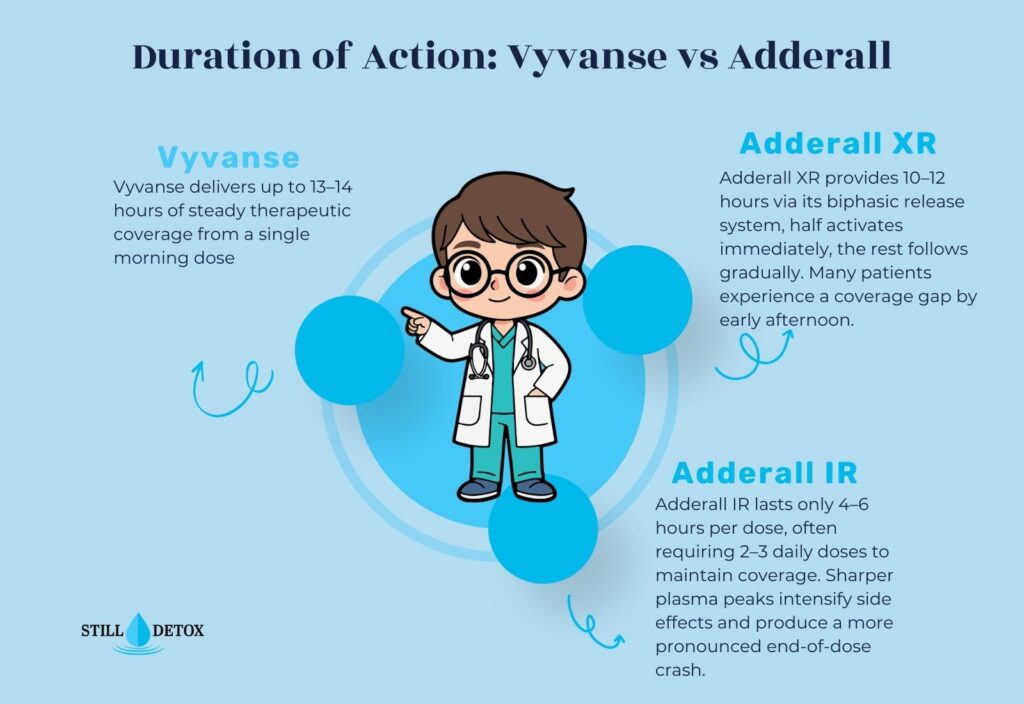
Dexamphetamine IR tablets typically last 4–6 hours per dose, requiring 2–3 daily doses for all-day coverage. This creates a segmented coverage pattern with predictable re-dosing intervals — and noticeable “on” and “off” transitions between doses.
Vyvanse provides 10–14 hours of coverage from a single dose. The sustained, consistent dextroamphetamine release produces a fundamentally different daily experience — one continuous arc of coverage rather than multiple shorter peaks.
For some patients, this is clearly preferable — for others, the granular control of shorter-acting doses is specifically valued.
Individual Response Variation
The Australian r/ausadhd and r/ADHD communities document a genuine phenomenon: some patients respond better to one delivery format despite identical active compounds. One patient account specifically states: “For me, dexamphetamine didn’t really work at a low-moderate dose and too high raised my HR and BP too much. It also felt too sudden and lasted too short. Even though Vyvanse is technically the same, it somehow worked better for me and on a lower dose”.
The pharmacological explanation for this is not fully established — but likely involves the rate-of-rise effect on dopamine receptor stimulation patterns, individual variation in enzymatic conversion efficiency for Vyvanse, and the different subjective experience of smooth versus sharp pharmacokinetic profiles.
The Abuse Potential Debate: Does Vyvanse Really Have Lower Misuse Risk?
This is one of the most contested pharmacological claims in the Vyvanse marketing narrative — and the recent evidence has significantly complicated it:
The original claim: Vyvanse’s prodrug design prevents abuse because crushing, snorting, or injecting it does not bypass the rate-limiting enzymatic conversion step — producing no faster or more intense effect than oral administration. This claim is valid for intranasal and intravenous routes of administration.
What the recent 2024 PubMed evidence adds:A 2024 PubMed literature review specifically examining the comparative abuse potential of oral dexamphetamine and lisdexamfetamine concluded: “The available evidence from pharmacodynamic, pharmacokinetic and abuse liability studies suggests a comparable potential for oral abuse of dexamphetamine and LDX”.
The key finding: because the enzymatic conversion step happens in the bloodstream after oral absorption, oral administration of lisdexamfetamine at supratherapeutic doses still produces the same peak dextroamphetamine concentrations as equivalent oral dextroamphetamine. The study also noted that “LDX showed linear dose proportional pharmacokinetics up to a dose of 250 mg, indicating a lack of overdose protection at supratherapeutic doses”.
The practical summary:
- Vyvanse has a clear advantage over dexamphetamine IR for non-oral routes (intranasal, intravenous) — the prodrug mechanism provides genuine abuse deterrence for these routes
- For oral misuse at high doses, the abuse potential of Vyvanse and dexamphetamine is pharmacologically comparable
- The TGA classifies both dexamphetamine and lisdexamfetamine as Schedule 8 controlled substances in Australia, reflecting equivalent regulatory assessment of abuse risk
The Australian Context: Dexamphetamine vs. Vyvanse Under the PBS
This comparison is particularly clinically relevant in Australia because both medications are available and PBS-listed, and prescribers actively choose between them:
Dexamphetamine in Australia is available as generic 5 mg tablets — the standard Australian ADHD prescribing building block. It requires a Schedule 8 permit in most Australian states and territories. It is the more established, lower-cost option and remains widely prescribed, particularly for children and for patients on government benefits for whom cost is a significant factor.
Vyvanse was listed on the Australian PBS in 2019 for ADHD in adults (6+ years) and for moderate-to-severe BED in adults. It also requires Schedule 8 prescribing authority. The TGA conducted a specific safety investigation into concerns about Vyvanse’s effectiveness in 2025 and found no issues of concern — confirming its efficacy and safety profile in the Australian context.
The GP’s decision framework between dexamphetamine and Vyvanse in Australian clinical practice involves:
- Patient preference for once-daily versus multi-dose regimens
- Coverage duration needs relative to daily schedule
- Whether the patient can reliably manage and store Schedule 8 IR tablets
- Cost under PBS arrangements
- Whether the smooth pharmacokinetic profile of Vyvanse is clinically preferable for a specific patient’s psychiatric or medical profile
- Whether the patient requires evening coverage or specifically wants no medication effect in the evening
Head-to-Head: Vyvanse vs. Dexamphetamine IR
The most useful direct comparison for patients deciding between these two options:
| Feature | Vyvanse (Lisdexamfetamine) | Dexamphetamine IR |
|---|---|---|
| Active compound | Dextroamphetamine (via prodrug) | Dextroamphetamine (direct) |
| Onset | 1–2 hours (gradual) | 30–60 minutes (faster) |
| Peak effect | 3–4 hours post-dose | 1–2 hours post-dose |
| Duration | 10–14 hours | 4–6 hours per dose |
| Dosing frequency | Once daily | 2–3 times daily |
| Dose forms | Capsule, chewable tablet | Tablet (IR only in Australia) |
| Coverage smoothness | Smooth, gradual arc | Peaks between doses, clear offset |
| Non-oral abuse deterrence | Yes (prodrug mechanism) | No |
| Oral abuse potential | Comparable to dexamphetamine | Comparable to Vyvanse |
| Approved uses | ADHD + BED | ADHD + narcolepsy |
| Schedule (Australia) | S8 | S8 |
| Cost | Higher | Lower (generic) |
When Vyvanse Is the Better Clinical Choice
Despite identical pharmacology, Vyvanse has genuine advantages in specific clinical contexts:
- All-day coverage from a single dose — for patients whose ADHD impacts an entire work or school day and into the evening, Vyvanse’s 10–14 hour duration eliminates the need for a midday re-dose
- Smoother pharmacokinetic experience — patients who experience the dexamphetamine IR “coming on” and “wearing off” as uncomfortable or disruptive may prefer Vyvanse’s gradual profile
- Adherence simplicity — once-daily dosing reduces the compliance burden for patients who struggle with remembering multiple daily doses
- Non-oral diversion concern — in household settings with adolescents or where intranasal misuse is a specific concern, Vyvanse’s route-specific abuse deterrence is a genuine advantage
- Individual response preference — some patients genuinely respond better to the Vyvanse delivery profile despite identical active compounds, likely due to rate-of-rise pharmacokinetic effects on subjective experience
- Binge eating disorder — Vyvanse is the only medication in this comparison approved for BED
When Dexamphetamine Is the Better Clinical Choice
Dexamphetamine has genuine clinical advantages for specific patients and contexts:
- Flexible, granular dosing — the ability to take 5 mg tablets in varying doses at multiple time points gives patients and prescribers much finer control over coverage timing and intensity
- Shorter coverage when preferred — patients who want to be unmedicated by mid-afternoon, who have significant insomnia concerns, or who want medication effects only during specific windows benefit from the 4–6 hour window
- Lower cost — generic dexamphetamine is significantly less expensive than Vyvanse, which matters for long-term treatment adherence in cost-sensitive patients
- Narcolepsy — approved for narcolepsy in both Australia and the US; Vyvanse is not
- Faster onset — for patients who need therapeutic effect quickly after waking (e.g., for an early meeting), dexamphetamine’s 30–60 minute onset is faster than Vyvanse’s 1–2 hour onset
- Dose titration simplicity for complex regimens — multiple small doses can be individually timed, which is clinically valuable for patients with variable daily demands
- Booster dosing with Vyvanse — many Australian patients and prescribers use dexamphetamine IR as a “booster” in the late afternoon when Vyvanse begins to wane, leveraging the advantages of both delivery profiles simultaneously
Safety and Important Considerations for Australian Patients
- Both medications are Schedule 8 in all Australian states and territories — requiring specialist initiation and S8 permit for prescribing outside certain exceptions. Victoria, in particular, has explicit permit requirements for GPs prescribing dexamphetamine or lisdexamfetamine
- The TGA’s 2025 investigation into Vyvanse specifically examined concerns about the Australian-market product’s effectiveness and quality, and found no issues of concern — confirming the medication’s safety and efficacy in the Australian prescribing context
- Do not attempt to self-convert between doses — the 2.5:1 conversion ratio is a pharmacokinetic calculation, not a clinically validated direct substitution formula; individual variation in metabolic conversion efficiency means that dose-finding after switching requires supervised titration
- Combining Vyvanse and dexamphetamine IR as a booster is used clinically in Australia but requires careful total daily dextroamphetamine dose monitoring — the combined dextroamphetamine load from both medications must be calculated using the 0.2948 conversion factor to ensure total daily dose remains within safe parameters
Common Misconceptions About Vyvanse vs. Dexamphetamine
Myth 1: “Vyvanse is a different, more advanced amphetamine than dexamphetamine.”Pharmacologically, they are the same molecule once Vyvanse has been converted. Vyvanse is an architectural innovation — a delivery system for dextroamphetamine that controls the timing of its release — not a fundamentally different or more advanced pharmacological compound.
Myth 2: “30 mg Vyvanse equals 30 mg dexamphetamine.”This is the most dangerous misconception and a source of serious dosing errors. 30 mg Vyvanse delivers approximately 8.9 mg of dextroamphetamine — less than one-third of 30 mg dexamphetamine. The molecular weight of the L-lysine component accounts for approximately 70.5% of Vyvanse’s mass — meaning that only 29.5% of the stated milligram dose represents active dextroamphetamine.
Myth 3: “Vyvanse has a lower abuse potential than dexamphetamine for oral use.”The route-specific abuse deterrence claim is valid — crushing and snorting Vyvanse does not accelerate its effect. However, the 2024 PubMed literature review found that oral abuse potential is comparable between lisdexamfetamine and dextroamphetamine at supratherapeutic doses. The TGA’s Schedule 8 classification of both medications reflects equivalent regulatory assessment.
Myth 4: “If dexamphetamine isn’t working well for me, Vyvanse will work better because it’s stronger.”If dexamphetamine at an adequate dose is not providing sufficient ADHD control, switching to Vyvanse at an equivalent dose will not change the core pharmacological effect — same active compound, same mechanism. However, the smooth delivery profile of Vyvanse may improve tolerability, reduce side effects from sharp peaks, and provide longer coverage — which can translate into a subjectively better experience even without increased pharmacological potency. The solution to inadequate dexamphetamine effect is typically dose optimisation or a class switch (to methylphenidate or a non-stimulant) — not Vyvanse, which is pharmacologically the same medication.
Is Vyvanse stronger than dexamphetamine Hobart
Is Vyvanse stronger than dexamphetamine Devonport
Is Vyvanse stronger than dexamphetamine Launceston
Is Vyvanse stronger than dexamphetamine Tasmania
Is Vyvanse stronger than dexamphetamine Victoria
Is Vyvanse stronger than dexamphetamine Queensland
Is Vyvanse stronger than dexamphetamine Canberra
Is Vyvanse stronger than dexamphetamine Australian Capital Territory
Is Vyvanse stronger than dexamphetamine South Australia
Is Vyvanse stronger than dexamphetamine New South Wales
Is Vyvanse stronger than dexamphetamine Darwin
Is Vyvanse stronger than dexamphetamine Ghan
Is Vyvanse stronger than dexamphetamine Northern Territory
Is Vyvanse stronger than dexamphetamine Australia
Is Vyvanse stronger than dexamphetamine Austria
Is Vyvanse stronger than dexamphetamine Germany
Is Vyvanse stronger than dexamphetamine United Kingdom
Is Vyvanse stronger than dexamphetamine Sweden
Is Vyvanse stronger than dexamphetamine Denmark
Is Vyvanse stronger than dexamphetamine Norway
Is Vyvanse stronger than dexamphetamine Finland
Is Vyvanse stronger than dexamphetamine Iceland
Is Vyvanse stronger than dexamphetamine Netherlands
Is Vyvanse stronger than dexamphetamine Spain
Is Vyvanse stronger than dexamphetamine Ireland
Is Vyvanse stronger than dexamphetamine Switzerland
FAQ: People Also Ask About Vyvanse vs. Dexamphetamine
Is Vyvanse the same as dexamphetamine?Pharmacologically yes — Vyvanse is a prodrug that converts entirely to dextroamphetamine in the bloodstream, and the dextroamphetamine it delivers is chemically identical to that in dexamphetamine tablets. The two medications are not the same in their pharmacokinetic delivery profile — Vyvanse reaches peak levels approximately 1 hour later and provides longer duration through rate-limited prodrug conversion. They are the same active compound delivered differently.
How does 30 mg Vyvanse compare to dexamphetamine?30 mg Vyvanse contains approximately 8.9 mg of dextroamphetamine — applying the 0.2948 conversion factor to the lisdexamfetamine molecular weight. This means 30 mg Vyvanse is equivalent to approximately 8.9 mg dexamphetamine in terms of active drug delivered — not 30 mg. The maximum approved Vyvanse dose of 70 mg delivers approximately 20.8 mg of dextroamphetamine.
Does Vyvanse last longer than dexamphetamine?Yes — substantially. Dexamphetamine IR provides 4–6 hours of coverage per dose; Vyvanse provides 10–14 hours from a single daily dose. This is the primary practical advantage of Vyvanse over dexamphetamine IR — not greater potency, but far longer and smoother coverage from a single daily administration.
Can I use dexamphetamine as a booster with Vyvanse?Yes — this is a recognised clinical strategy in Australian ADHD management. Dexamphetamine IR tablets taken in the late afternoon can extend coverage as Vyvanse begins to wear off, without requiring a full Vyvanse dose that would cause late-night insomnia. The total daily dextroamphetamine load from both medications combined must be calculated using the conversion factor and monitored to remain within appropriate dose ranges.
Why does Vyvanse feel smoother than dexamphetamine?The rate of rise of plasma dextroamphetamine is slower and more gradual with Vyvanse — approximately 1 hour delayed and with a flatter concentration-time curve relative to dexamphetamine IR. A slower rate of dopamine elevation produces a less abrupt “coming on” sensation, less pronounced peak effects, and a more gradual offset — which many patients describe as smoother or gentler. The total drug exposure is the same; the temporal distribution of that exposure is different.
Is dexamphetamine cheaper than Vyvanse in Australia?Yes — generic dexamphetamine tablets are substantially less expensive than branded Vyvanse. GoodRx US pricing as a directional reference: dextroamphetamine 10 mg (60 tablets) at approximately $40 versus Vyvanse 30 mg (30 capsules) at approximately $68 at lowest cash prices. In the Australian PBS context, both medications are subsidised for eligible patients; for patients not meeting PBS criteria or paying private prices, the cost differential is significant and practically relevant to long-term adherence.
