
Is Vyvanse stronger than Ritalin? In head-to-head clinical trial data, Vyvanse is measurably more effective than Ritalin — lisdexamfetamine produced a statistically significantly greater improvement in ADHD symptoms than osmotic-release methylphenidate (OROS-MPH/Concerta), with a between-group difference of -5.6 points on the ADHD-RS-IV scale (p<0.001) and a number needed to treat (NNT) of 6. A landmark 2018 Lancet Psychiatry network meta-analysis of 133 randomised controlled trials across all ADHD medications confirmed that amphetamines (including Vyvanse) have a larger effect size than methylphenidate in adults — with effect sizes of SMD -0.89 for lisdexamfetamine versus SMD -0.50 for methylphenidate. However, “stronger” does not mean “better for everyone” — the same landmark meta-analysis recommended methylphenidate as the preferred first-choice medication for children and adolescents, reserving amphetamines as first choice for adults, reflecting that the superiority in efficacy comes with a meaningfully different and in some respects more challenging side effect profile.
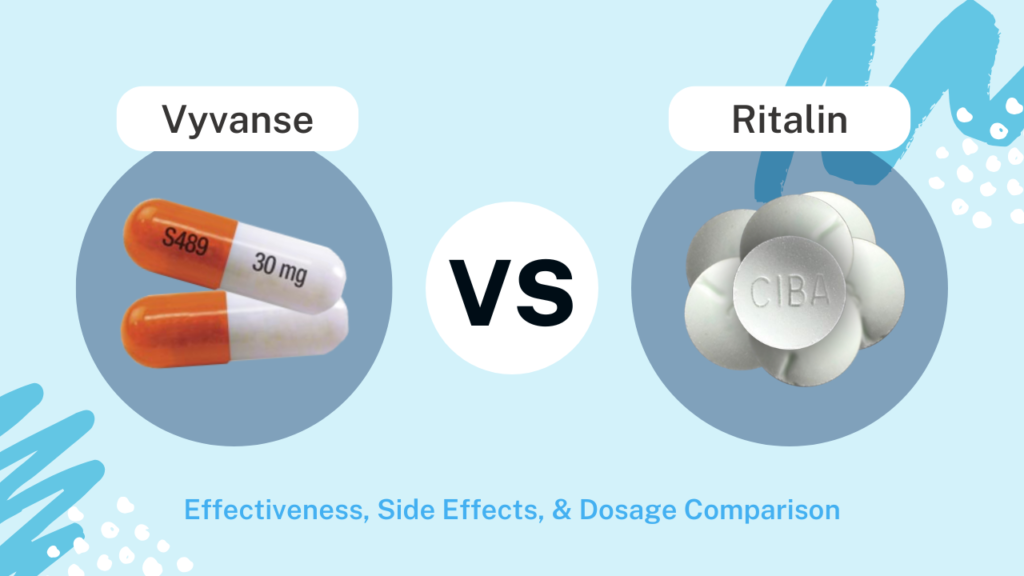
The Fundamental Difference: Different Drugs, Different Mechanisms
Before comparing effectiveness, it is critical to understand that Vyvanse and Ritalin are not the same type of medication — they belong to different pharmacological classes and work through fundamentally different mechanisms:
| Feature | Vyvanse (Lisdexamfetamine) | Ritalin (Methylphenidate) |
|---|---|---|
| Drug class | Amphetamine prodrug | Methylphenidate |
| Active metabolite | Dextroamphetamine | Methylphenidate |
| Primary mechanism | Forces dopamine release + blocks reuptake | Blocks reuptake only |
| Norepinephrine effect | Strong — more potent NE release than DA | Moderate — primarily DA/NE reuptake blockade |
| Duration (standard) | 10–14 hours (once daily) | 3–5 hours IR; 8–12 hours ER (Concerta) |
| Formulations | Extended-release capsule/chewable only | IR tablets + multiple ER formulations |
| Approved uses | ADHD + binge eating disorder | ADHD + narcolepsy |
| Abuse potential | Lower oral abuse risk (prodrug) | Higher than Vyvanse IR; lower than amphetamine IR |
| Psychosis risk | ~2x higher than methylphenidate | No significant dose-dependent psychosis risk |
The core pharmacological distinction: Ritalin works only by blocking the reuptake of dopamine and norepinephrine — it prevents their removal from the synapse after release. Vyvanse additionally and more powerfully forces dopamine and norepinephrine out of presynaptic neurons via reverse transport at the dopamine and norepinephrine transporters — a fundamentally more potent mechanism that explains both the stronger clinical effect and the greater side effect burden.
The Efficacy Evidence: What the Research Shows
The Head-to-Head Trial
The most clinically direct comparison comes from a head-to-head randomised controlled trial comparing lisdexamfetamine to osmotic-release methylphenidate (OROS-MPH, the extended-release formulation used in Concerta):
- Lisdexamfetamine produced statistically significantly greater improvement in ADHD-RS-IV total scores
- The between-group difference was -5.6 points (p<0.001) — a clinically meaningful gap, not merely a statistical artefact
- The number needed to treat (NNT) of 6 means that for every 6 patients treated with lisdexamfetamine instead of OROS-MPH, one additional patient achieves a meaningful treatment response they would not have achieved on methylphenidate
The Lancet Psychiatry Meta-Analysis (133 RCTs, 2018)
The most comprehensive and authoritative meta-analysis on ADHD medication efficacy — published in The Lancet Psychiatry and involving 133 randomised controlled trials — found:
- In adults: Amphetamines (including lisdexamfetamine) were more efficacious than methylphenidate in head-to-head comparisons, with larger standardised mean differences on ADHD symptom measures
- In children and adolescents: Methylphenidate was preferred on the balance of efficacy and tolerability — not because it is more effective on raw symptom scores, but because amphetamines were significantly less well tolerated in this age group (odds ratio for tolerability problems: 2.30 in children, 3.26 in adults)
- The researchers’ explicit recommendation: “Evidence from this meta-analysis supports methylphenidate in children and adolescents, and amphetamines in adults, as preferred first-choice medications”
The Effect Size Data
The most precise efficacy quantification comes from the meta-analysis effect size data:
- Lisdexamfetamine (Vyvanse): Standardised mean difference (SMD) = -0.89 — the largest effect size of any ADHD medication in adult trials
- Mixed amphetamine salts (Adderall): SMD = -0.64
- Methylphenidate (Ritalin/Concerta): SMD = -0.50
An SMD of 0.89 versus 0.50 represents a 78% larger effect size for Vyvanse over methylphenidate in adult ADHD — a pharmacologically and clinically substantial difference.
Why the Age-Dependent Difference Matters
The age-stratified recommendation — methylphenidate for children, amphetamines for adults — is one of the most clinically important nuances in the ADHD pharmacology literature and is frequently overlooked in patient-facing discussions:
In children and adolescents:
- Both medications are effective, but the stronger dopaminergic effect of amphetamines relative to the developing brain produces a less favourable tolerability profile
- Methylphenidate’s more targeted reuptake-blockade mechanism may be more precisely calibrated to the paediatric neurological context
- Tolerability problems (anxiety, appetite suppression, emotional effects) are more pronounced with amphetamines in children
In adults:
- The fully developed adult brain responds to amphetamines’ larger dopaminergic effect with proportionally greater cognitive benefit
- Adults generally tolerate the stronger side effect profile more readily than children
- The effect size advantage of amphetamines over methylphenidate is consistent and robust across adult trials
The clinical implication: a child who responded adequately to Ritalin should not be switched to Vyvanse purely on the basis of “it’s stronger” — stronger is not automatically better in the paediatric context, and the increased side effect burden may not be worth the marginal additional efficacy. An adult who has had a suboptimal response to methylphenidate, however, has good evidence-based justification to trial an amphetamine-class medication.
Duration of Action: A Practical Advantage for Vyvanse
One of the clearest practical differences between the two medications — and one of the most clinically important for daily life:
Ritalin (IR formulation):
- Onset: 20–30 minutes
- Peak: 1–2 hours
- Duration: 3–5 hours
- Requires 2–3 daily doses for all-day coverage
- Each re-dose can produce a re-peak, creating a less smooth experience
Vyvanse:
- Onset: 1–2 hours (gradual, due to prodrug conversion)
- Peak: 3–4 hours
- Duration: 10–14 hours
- Single daily dose provides coverage from morning through evening
- The prodrug mechanism produces a smooth, gradual onset and offset — no sharp peaks, no re-dosing
For many patients — particularly adults with demanding work schedules, evening responsibilities, or social obligations — the difference between a 4-hour and a 12-hour coverage window is not a minor convenience issue; it is a fundamental quality-of-life difference. Ritalin’s extended-release versions (Ritalin LA, Concerta) provide up to 8–12 hours of coverage — narrowing but not fully closing the duration gap.
Side Effect Comparison: Where They Differ
Both medications share the core stimulant side effect profile, but differ in their specific patterns and severity:
Shared Side Effects (Both Medications)
- Decreased appetite and weight loss
- Insomnia and sleep disruption
- Increased heart rate and blood pressure
- Dry mouth
- Headache
- Anxiety and irritability
- Growth suppression in children (with long-term use)
Where Vyvanse Has a Higher Risk Profile
- Psychosis and mania: Vyvanse carries approximately double the psychosis risk of methylphenidate at equivalent therapeutic doses — the NEJM study found 0.21% on amphetamines vs 0.10% on methylphenidate. Multiple methylphenidate-specific studies found no significant dose-dependent increase in psychosis risk, unlike the robust dose-response relationship found for amphetamines
- Cardiovascular side effects: Greater norepinephrine release from Vyvanse produces larger mean blood pressure and heart rate elevations compared to methylphenidate
- Metabolic effects: Larger weight loss and metabolic rate elevation due to stronger sympathomimetic activation
- Sweating and body odour: More pronounced due to greater norepinephrine-driven sympathetic activation
- Hormonal effects: Vyvanse specifically elevates adrenal androgens (DHEA, DHEA-S, androstenedione) via HPA axis activation; methylphenidate has a more limited effect on the HPA axis
- Overall tolerability: Amphetamines are less well tolerated than methylphenidate in head-to-head comparisons — odds ratio 2.30 in children and 3.26 in adults for discontinuation due to tolerability
Where Ritalin Has a Distinct Risk Profile
- Priapism (painful, prolonged erection): Listed as a specific Ritalin warning not shared by Vyvanse
- Drug interactions: Ritalin inhibits the CYP enzyme system less broadly than Vyvanse, producing fewer drug-drug interaction concerns
- More complex dosing with IR: Multiple daily doses create more opportunities for missed doses, rebound effects, and timing errors
Abuse Potential and Diversion Risk
This is a clinically and practically important distinction, particularly in household settings with multiple family members or in workplace environments:
Vyvanse has a significantly lower oral abuse potential than Ritalin (IR):
- Vyvanse’s prodrug design means that the lisdexamfetamine molecule requires enzymatic conversion in the bloodstream to become active
- This rate-limiting conversion step blunts the sharp dopamine peak responsible for euphoria and reinforcement
- Crushing and snorting or injecting Vyvanse does not produce a faster or more intense effect than swallowing it, because the activation bottleneck is in the bloodstream — not in absorption
- Clinical trials specifically designed to assess abuse potential confirmed that Vyvanse produces significantly lower subjective “drug liking” scores than equivalent dextroamphetamine at standard doses
Ritalin (IR) has higher diversion and abuse potential:
- Standard methylphenidate tablets can be crushed, dissolved, and misused
- The sharp, rapid dopamine peak from Ritalin IR produces measurable euphoric effects at higher doses that Vyvanse’s pharmacokinetics largely prevent
This distinction is directly relevant for families where ADHD medication diversion is a concern, for patients with personal or family history of substance use disorder, and for healthcare environments — it is one of the primary pharmacological rationales for choosing Vyvanse over a short-acting stimulant when abuse potential is a clinical consideration.
Which Is Better for You? The Decision Framework
The evidence does not support a universal answer — it supports a patient-specific answer based on the following key factors:
Choose Vyvanse When:
- You are an adult whose ADHD requires all-day coverage without re-dosing
- You have had a suboptimal response to methylphenidate — the evidence base specifically supports amphetamines as the next step in this scenario
- Your life demands consistent, smooth 12-hour coverage — work, driving, social responsibilities through the evening
- Abuse potential or diversion risk is a specific concern — Vyvanse’s prodrug design makes it harder to misuse
- You also have binge eating disorder — Vyvanse is the only medication in this comparison approved for BED
- The prescriber assessment supports amphetamine-class treatment as first-line for your adult ADHD presentation
Consider Ritalin (or Concerta) When:
- You are a child or adolescent — the Lancet meta-analysis recommends methylphenidate as first-line for this age group
- You have personal or family history of psychosis or bipolar disorder — methylphenidate’s substantially lower psychosis risk makes it a safer first-line choice
- You need shorter coverage — Ritalin IR’s 3–5 hour window can be appropriate for specific contexts (afternoon-only treatment, homework coverage only)
- You are taking multiple medications with interaction concerns — methylphenidate has fewer drug interactions than Vyvanse
- Cost is a significant factor — generic methylphenidate is substantially less expensive than Vyvanse, which in Australia requires specific subsidy criteria for PBS coverage
- You experienced intolerable side effects on amphetamines — some patients simply tolerate methylphenidate better
When the Answer Genuinely Is “Try Both”
- Many patients and prescribers need to trial both classes to determine individual response
- Because ADHD neurobiology is heterogeneous — not all ADHD brains respond identically to the same pharmacological mechanism — population-level effect size data does not predict individual response
- The Australian ADHD prescribing context allows for systematic trials of both medication classes under Schedule 8 monitoring
Cost and Access in Australia
Vyvanse is available on the Australian Pharmaceutical Benefits Scheme (PBS) for ADHD, with specific eligibility criteria that require specialist diagnosis. At the time of this article, standard PBS co-payment applies for eligible patients; private price significantly higher.
Ritalin and Concerta are also PBS-listed for ADHD, with methylphenidate generally having a longer PBS approval history and broader initial prescribing access in some clinical contexts.
For patients paying privately, GoodRx data (US market) shows the cost disparity is substantial: Vyvanse 30 mg (30 capsules) has a cash price of approximately $389 versus approximately $133 for methylphenidate 10 mg (90 tablets). Australian private pricing follows a similar directional relationship — methylphenidate generics are significantly less expensive than branded Vyvanse.
Safety and Important Considerations for Australian Adults
- The Australian ADHD prescribing guidelines reflect the international evidence: methylphenidate-class medications are typically trialled before amphetamines in paediatric patients; amphetamines have a stronger evidence base in adults
- Both medications are Schedule 8 controlled substances in Australia — requiring specialist initial prescription and regular review with monitoring
- The psychosis risk difference between the two medications is one of the most clinically significant distinctions for prescribing decisions in patients with personal or family psychiatric history. Australian psychiatrists managing patients with complex comorbidities typically consider this differential when selecting ADHD pharmacotherapy
- Switching from Ritalin to Vyvanse — or vice versa — requires careful dose conversion and titration; there is no simple milligram-for-milligram equivalence between the two drug classes
Common Misconceptions About Vyvanse vs. Ritalin
Myth 1: “Stronger means better — I should ask for Vyvanse if Ritalin isn’t working perfectly.”The evidence supports a specific clinical pathway: if methylphenidate produces meaningful but incomplete benefit, an amphetamine trial is evidence-based. However, if methylphenidate is working well with acceptable tolerability, there is no pharmacological justification for switching to a stronger medication — the additional potency comes with additional risk, not just additional benefit.
Myth 2: “Ritalin is old-fashioned and less effective — Vyvanse is the modern upgrade.”Methylphenidate is older, but the 2018 Lancet meta-analysis — the most comprehensive ADHD pharmacotherapy study ever conducted — recommended it as first-line for children and adolescents based on the totality of evidence including tolerability. “Newer” and “stronger” do not automatically mean “better” in clinical pharmacology; the right medication is the one that achieves adequate therapeutic response with the best tolerability profile for the individual patient.
Myth 3: “They work the same way, just with different durations.”They work through fundamentally different mechanisms — Ritalin uses only reuptake blockade; Vyvanse additionally uses forced dopamine release via reverse transport. This is not a duration difference — it is a pharmacological class difference that produces meaningfully different dopamine elevation magnitude, side effect profiles, cardiovascular effects, psychosis risk, and abuse potential.
Myth 4: “Vyvanse is always safer because it’s a prodrug.”The prodrug mechanism makes Vyvanse safer specifically in the context of oral abuse potential. It does not make Vyvanse safer in terms of cardiovascular effects, psychosis risk, hormonal effects, or metabolic impact — in all of these respects, methylphenidate has a more favourable safety profile than Vyvanse.
Is Vyvanse stronger than Ritalin Hobart
Is Vyvanse stronger than Ritalin Devonport
Is Vyvanse stronger than Ritalin Launceston
Is Vyvanse stronger than Ritalin Tasmania
Is Vyvanse stronger than Ritalin Victoria
Is Vyvanse stronger than Ritalin Queensland
Is Vyvanse stronger than Ritalin Canberra
Is Vyvanse stronger than Ritalin Australian Capital Territory
Is Vyvanse stronger than Ritalin South Australia
Is Vyvanse stronger than Ritalin New South Wales
Is Vyvanse stronger than Ritalin Darwin
Is Vyvanse stronger than Ritalin Ghan
Is Vyvanse stronger than Ritalin Northern Territory
Is Vyvanse stronger than Ritalin Australia
Is Vyvanse stronger than Ritalin Austria
Is Vyvanse stronger than Ritalin Germany
Is Vyvanse stronger than Ritalin United Kingdom
Is Vyvanse stronger than Ritalin Sweden
Is Vyvanse stronger than Ritalin Denmark
Is Vyvanse stronger than Ritalin Norway
Is Vyvanse stronger than Ritalin Finland
Is Vyvanse stronger than Ritalin Iceland
Is Vyvanse stronger than Ritalin Netherlands
Is Vyvanse stronger than Ritalin Spain
Is Vyvanse stronger than Ritalin Ireland
Is Vyvanse stronger than Ritalin Switzerland
FAQ: People Also Ask About Vyvanse vs. Ritalin
Is Vyvanse stronger than Ritalin?Yes — by multiple measures. Head-to-head clinical trial data shows a statistically significant -5.6 point ADHD-RS-IV advantage for lisdexamfetamine over OROS-methylphenidate. Meta-analysis effect sizes confirm lisdexamfetamine’s SMD of -0.89 versus methylphenidate’s -0.50 in adults. The pharmacological basis is Vyvanse’s dual mechanism — forced dopamine release plus reuptake blockade — versus Ritalin’s single mechanism of reuptake blockade alone.
Which is better for adults — Vyvanse or Ritalin?The 2018 Lancet Psychiatry meta-analysis — the most authoritative available evidence — recommends amphetamines (including Vyvanse) as the preferred first-choice medication for adult ADHD, with methylphenidate preferred for children and adolescents. In adults, Vyvanse has both a larger effect size and a more convenient once-daily dosing schedule. Individual factors — including psychiatric history, cardiovascular status, and medication interactions — may change this recommendation for a specific patient.
Which is better for children — Vyvanse or Ritalin?The Lancet meta-analysis recommends methylphenidate as first-line for children and adolescents — not because methylphenidate has a larger effect size, but because amphetamines are significantly less well tolerated in this age group. The odds ratio for tolerability problems with amphetamines versus methylphenidate was 2.30 in children — meaning children are more than twice as likely to experience side effects significant enough to discontinue treatment. Vyvanse may be trialled in children who do not respond adequately to methylphenidate, but it is not the recommended starting point.
Does Vyvanse last longer than Ritalin?Substantially — Vyvanse provides 10–14 hours of coverage from a single daily dose; Ritalin IR provides 3–5 hours, requiring 2–3 daily doses for equivalent coverage. Ritalin’s extended-release formulations (Concerta, Ritalin LA) provide 8–12 hours — closer to Vyvanse but still with somewhat shorter and less smooth coverage due to the differences in pharmacokinetic profiles.
Does Vyvanse have more side effects than Ritalin?The Lancet meta-analysis found amphetamines were less well tolerated than methylphenidate in both children and adults — odds ratios of 2.30 and 3.26 respectively for tolerability-related discontinuation. Vyvanse specifically carries a higher psychosis risk (approximately double), greater cardiovascular effects, more pronounced sweating and metabolic effects, and broader drug interactions. Ritalin’s specific risks include priapism (men) and somewhat higher oral abuse potential in immediate-release form.
Can I switch from Ritalin to Vyvanse?Yes — this is one of the most common medication transitions in ADHD management, particularly when methylphenidate produces suboptimal symptom control. There is no simple mg-for-mg conversion between the two drug classes; dose titration should start at a low Vyvanse dose (20–30 mg) regardless of the previous methylphenidate dose, with upward titration under prescriber guidance. Clinical evidence specifically supports this transition: a study found that patients who had previously responded inadequately to methylphenidate showed a “faster and more robust treatment response” to lisdexamfetamine than to atomoxetine as the next step.
