
How long Vyvanse anxiety lasts depends almost entirely on when in the day it occurs, because there are three pharmacologically distinct types of Vyvanse-related anxiety — each with its own timeline and its own cause. Onset anxiety (during the first 1–3 hours) typically lasts 1–3 hours and often resolves on its own. Peak-window anxiety (during the 3–8 hour active period) lasts as long as the dose does and is the clearest signal of a too-high dose. Rebound anxiety (as the medication wears off, 8–14 hours after dosing) typically lasts 30–90 minutes but can extend to several hours. Early-treatment adjustment anxiety from the first weeks of starting Vyvanse often resolves within 1–3 weeks as the brain adapts.
Why “How Long” Is the Wrong First Question — And What to Ask Instead
The duration of Vyvanse anxiety is only useful information once you know which type of anxiety you’re experiencing. Asking how long it lasts without identifying the type is like asking how long a headache lasts without knowing whether it’s a tension headache, a migraine, or a symptom of something else entirely — the answer is different for each.
Before tracking duration, identify the timing pattern by noting:
- Does the anxiety arrive during the first hour or two after dosing?
- Does it persist through the medicated window — the peak of the medication’s effect?
- Does it arrive specifically as the medication wears off — in the late afternoon or evening?
- Is it present every day, or only in the first weeks of treatment?
The answer shapes both the expected duration and the appropriate clinical response.
The Three Types of Vyvanse Anxiety — With Durations
Type 1: Onset Anxiety (First 1–3 Hours After Dosing)
What it is: Anxiety that arrives as lisdexamfetamine is being converted to dextroamphetamine and blood levels are rising. Some individuals experience an initial period of heightened alertness, jitteriness, and anxiety during the build phase — before the medication has reached its plateau.
How long it lasts: Typically 1–3 hours — resolving once dextroamphetamine blood levels stabilise at their plateau. Most patients who experience onset anxiety describe it disappearing by the time the medication is fully active.
Who experiences it: Most common in patients who are new to Vyvanse (first days to weeks), those on higher doses, those who took it on an empty stomach, and those with pre-existing anxiety sensitivity.
Whether it improves over time: Frequently, yes. As one patient described: “I experience anxiety during the first roughly three hours. I’ve discovered that staying active and concentrating on something — like vacuuming — keeps it at bay. Usually it disappears for the rest of the day”. Many patients find onset anxiety substantially reduces after 2–3 weeks as the brain adapts.
Type 2: Peak-Window Anxiety (3–8 Hours After Dosing)
What it is: Anxiety that persists throughout the medicated window — during the period of maximum pharmacological effect, typically between hours 3 and 8 post-dose. This is the most clinically significant type because it indicates a dose-exposure mismatch — the amount of dextroamphetamine reaching peak blood concentration is above the individual’s personal therapeutic threshold.
How long it lasts: For as long as the medication is at or near peak — typically 4–6 hours per dose, running throughout the primary active window. It does not resolve on its own during the day; it persists until dextroamphetamine levels begin to decline.
Who experiences it: Most commonly in patients whose current dose is too high for their individual neurochemistry, those with a primary anxiety disorder that is being amplified by stimulant-driven sympathetic activation, and those combining Vyvanse with caffeine or other stimulants.
Whether it improves over time: This type does not reliably self-resolve — if anxiety persists throughout the entire peak window at a stable dose after 2–3 weeks, a dose reduction is the appropriate intervention. It is the clearest clinical signal that the dose needs adjustment.
Type 3: Rebound Anxiety (Late Afternoon to Evening, 8–14 Hours After Dosing)
What it is: Anxiety that arrives specifically as Vyvanse wears off — as dextroamphetamine blood levels decline toward baseline and the neurochemical environment readjusts. This is commonly called the “Vyvanse crash” and can include anxiety, irritability, emotional sensitivity, low mood, and fatigue.
How long it lasts: Typically 30–90 minutes at its most intense, with a gradual reduction over the following 1–3 hours. Most patients describe it as a distinct wave that arrives and then progressively resolves by mid-evening. As one patient described precisely: “I get quite severe anxiety when it is going out of my system — it usually lasts around 60 minutes and then gets milder until disappearing later in the evening”.
A small proportion of patients experience rebound anxiety that extends significantly longer — particularly those on higher doses (where the drop from peak to baseline is more pronounced), those with pre-existing anxiety disorders, or those who have not eaten or slept adequately.
Whether it improves over time: Rebound anxiety frequently persists without active management — it is a pharmacological phenomenon tied to the drug’s clearance rather than an adjustment effect. It responds well to practical management strategies (see below) and in some cases warrants a prescriber review for timing or dose adjustment.
Type 4: Early-Treatment Adjustment Anxiety (First 1–3 Weeks)
What it is: General heightened anxiety in the first days to weeks of starting Vyvanse, present throughout the day regardless of specific timing within the dosing cycle. This reflects the brain and body adjusting to a significant neurochemical change rather than a stable side effect pattern.
How long it lasts: Clinical and patient experience consistently suggests 1–3 weeks for this type of anxiety to settle, if it is going to settle. One commonly referenced community guide notes: “It usually takes around three weeks before you even know what a certain dose is doing to you”. Another patient described: “It took roughly ten days before I felt any improvement, but my life had been chaotic for decades because of untreated ADHD. Once I became more self-aware and made some changes, things improved significantly”.
Whether it improves over time: Frequently yes — this is the most likely type to self-resolve as tolerance to the initial stimulant effect develops. By weeks 2–3, many patients report improved emotional regulation and reduced anxiety compared to the first week. If adjustment anxiety has not significantly improved by week 3, a prescriber review is warranted.
The Pharmacokinetic Timeline: Why Anxiety Appears When It Does
Understanding Vyvanse’s pharmacology explains the timing of each anxiety type:
| Phase | Timing | What’s Happening | Anxiety Risk |
|---|---|---|---|
| Pre-peak build | 0–3.5 hours post-dose | Lisdexamfetamine converting to dextroamphetamine; blood levels rising | Onset anxiety in sensitive individuals |
| Peak window | 3.5–8 hours | Maximum dextroamphetamine blood concentration; full pharmacological effect | Peak anxiety if dose above personal threshold |
| Plateau decline | 8–12 hours | Dextroamphetamine levels declining; effect gradually reducing | Low risk — transition period |
| Crash window | 10–14 hours | Blood levels approaching baseline; neurochemical readjustment | Rebound anxiety as dopamine/norepinephrine normalise |
| Post-clearance | 14+ hours | Medication effectively cleared | Resolution for most patients |
This timeline is based on Vyvanse’s documented pharmacokinetics: T-max approximately 3.5 hours, clinical action 10–13 hours, and half-life of 10–11.3 hours in adults.
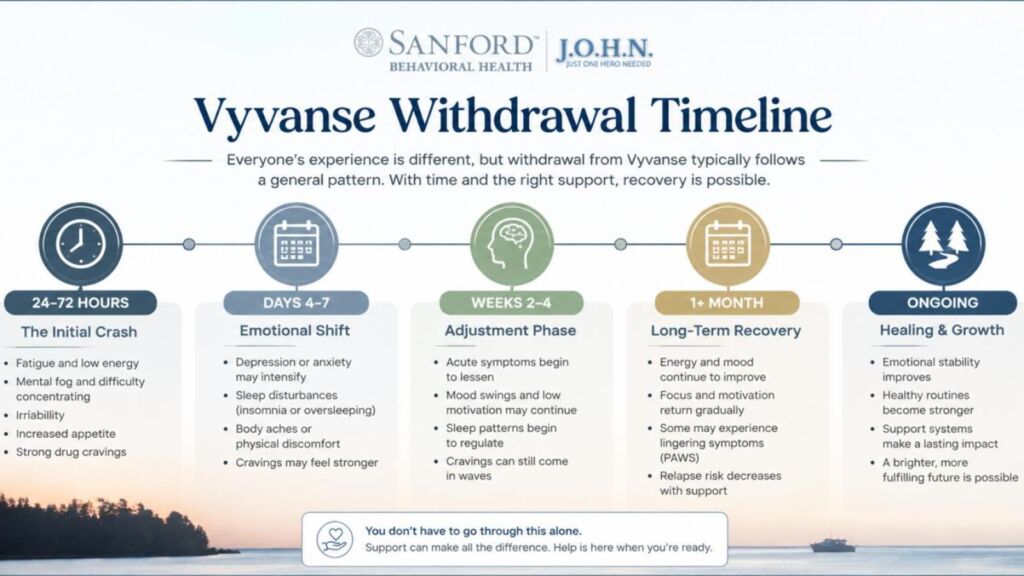
How Long Does Vyvanse Anxiety Last If You Just Started?
The first week is almost always the most anxious for patients who are going to experience Vyvanse-related anxiety — and it is the period least predictive of what long-term use will feel like.
In the first days, the brain has no established equilibrium with the neurochemical change Vyvanse introduces. The dopamine and norepinephrine surge relative to an unmedicated baseline can produce physiological arousal — elevated heart rate, heightened alertness, and anxiety — that feels alarming even when it is a temporary adjustment phenomenon.
The clinical and community evidence consistently indicates:
- Week 1: Often the most intense anxiety — the period of greatest neurochemical adjustment
- Weeks 2–3: Anxiety typically reduces meaningfully as neuroadaptation occurs
- Beyond week 3: Persistent anxiety at this point is unlikely to be an adjustment effect and warrants prescriber review
This does not mean everyone should simply wait three weeks through any level of anxiety — severe anxiety or panic attacks at any point warrant immediate prescriber contact.
- How long does Vyvanse anxiety last Hobart
- How long does Vyvanse anxiety last Devonport
- How long does Vyvanse anxiety last Launceston
- How long does Vyvanse anxiety last Tasmania
- How long does Vyvanse anxiety last Victoria
- How long does Vyvanse anxiety last Queensland
- How long does Vyvanse anxiety last Canberra
- How long does Vyvanse anxiety last Australian Capital Territory
- How long does Vyvanse anxiety last South Australia
- How long does Vyvanse anxiety last New South Wales
- How long does Vyvanse anxiety last Darwin
- How long does Vyvanse anxiety last Ghan
- How long does Vyvanse anxiety last Northern Territory
- How long does Vyvanse anxiety last Australia
- How long does Vyvanse anxiety last Austria
- How long does Vyvanse anxiety last Germany
- How long does Vyvanse anxiety last United Kingdom
- How long does Vyvanse anxiety last Sweden
- How long does Vyvanse anxiety last Denmark
- How long does Vyvanse anxiety last Norway
- How long does Vyvanse anxiety last Finland
- How long does Vyvanse anxiety last Iceland
- How long does Vyvanse anxiety last Netherlands
- How long does Vyvanse anxiety last Spain
- How long does Vyvanse anxiety last Ireland
- How long does Vyvanse anxiety last Switzerland
How Long Does Vyvanse Rebound Anxiety Last? (The Crash)
Rebound anxiety — the crash — is the most predictable and patterned of the anxiety types and the one most patients find most disruptive because it arrives during family or social evening time.
The standard timeline for a Vyvanse crash is:
- Onset: Typically 8–12 hours after dosing for most patients; some experience earlier crashes at 6–8 hours, particularly on lower doses with faster individual metabolism
- Peak severity: Usually within 30–60 minutes of onset — the sharpest part of the descent
- Duration: 30–90 minutes at peak intensity for most patients, with a subsequent 1–2 hour gradual resolution
- Full resolution: Most patients are back to or near baseline mood by 2–3 hours after the crash begins; full resolution before sleep for the majority
Factors that worsen crash duration and intensity:
- Higher doses (more pronounced peak-to-baseline drop)
- Inadequate food intake through the day
- Dehydration
- Insufficient sleep the previous night
- High stress or emotional demands during the crash window
- Pre-existing anxiety or mood conditions
Factors that reduce crash duration and severity:
- Eating a protein-rich snack in the late afternoon (2–3 hours before the anticipated crash)
- Adequate hydration through the day
- Light physical activity during the crash window — multiple patient reports confirm a brisk walk significantly reduces crash severity and duration
- Consistent sleep and dosing timing
- Stress reduction strategies before the evening window
Will Vyvanse Anxiety Get Better Over Time?
The answer is strongly type-dependent:
Early-adjustment anxiety: Very likely to improve significantly within 1–3 weeks for most patients. This type reflects neurochemical novelty rather than a stable pharmacological mismatch.
Onset anxiety: Frequently improves over weeks 1–4 as the brain adapts to the dosing pattern. Many patients who had noticeable onset anxiety in their first weeks report it has largely disappeared at the same dose by week 4–6.
Peak-window anxiety: Does not reliably improve over time without dose adjustment. This type is a signal of dose-exposure mismatch, not neurochemical novelty. Waiting for it to improve at the same dose is both clinically inappropriate and poor quality-of-life management.
Rebound anxiety: Unlikely to fully self-resolve without management, but often substantially reducible through the lifestyle strategies described above. If rebound anxiety is severe, persistent, or significantly impacting evening wellbeing, prescriber review is warranted.
