
Is Vyvanse stronger than Adderall? Vyvanse is not straightforwardly stronger than Adderall — and no direct head-to-head randomised controlled trial comparing the two has ever been published, making definitive superiority claims impossible on current evidence. What is known with precision is this: Adderall contains a more complex amphetamine mixture — 75% dextroamphetamine plus 25% levoamphetamine — while Vyvanse converts entirely to pure dextroamphetamine. Levoamphetamine produces a stronger peripheral sympathomimetic effect; dextroamphetamine produces a stronger CNS effect on attention and executive function. At equivalent doses Adderall delivers its amphetamine immediately and reaches peak plasma levels faster, while Vyvanse delivers the same active compound approximately 1–1.5 hours later with a longer and smoother duration. For practical efficacy in treating ADHD, both achieve 70–80% response rates and are considered equally effective first-line treatments for adults.
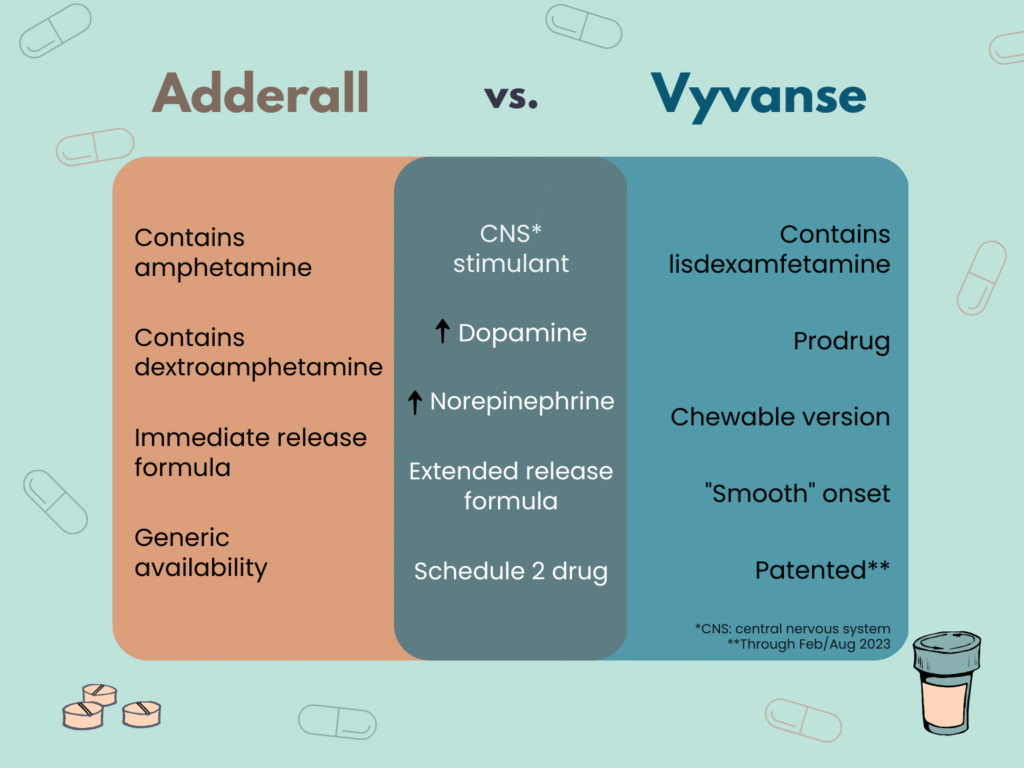
The Critical Compositional Difference
Understanding the “stronger” question requires first understanding that Adderall and Vyvanse are not the same drug — they share part of their pharmacology but differ meaningfully in composition:
Adderall’s composition:Adderall contains mixed amphetamine salts (MAS) — a specific 3:1 mixture of dextroamphetamine to levoamphetamine:
- 75% dextroamphetamine — the D-isomer; stronger CNS effect, more potent for improving attention and executive function, greater mesolimbic dopamine elevation
- 25% levoamphetamine — the L-isomer; stronger peripheral sympathomimetic effect (heart rate, blood pressure, body temperature elevation), contributes to the more pronounced physical “stimulant” sensation many patients describe
Vyvanse’s active compound:Vyvanse converts entirely to pure dextroamphetamine — the D-isomer only. There is no levoamphetamine component in Vyvanse.
The clinical consequence of this difference:Because Adderall contains levoamphetamine — which produces stronger peripheral stimulation — many patients describe Adderall as feeling physically more intense: higher heart rate awareness, more physical “buzz,” stronger appetite suppression onset. Because Vyvanse is pure dextroamphetamine — the CNS-selective isomer — many patients describe it as feeling more cognitively focused with less peripheral stimulation. The Reddit patient community captures this well: “Levo-amphetamine produces a stronger physical stimulant effect than dextro-amphetamine. Because Vyvanse contains only dextro-amphetamine, it is usually better tolerated”.
The Pharmacokinetic Difference: Delivery Profile
The second critical difference — and the one that matters most for daily clinical experience — is how rapidly and smoothly each medication delivers amphetamine:
Adderall IR (immediate-release):
- Active amphetamine salts begin absorbing immediately
- Onset: 30–60 minutes
- Peak plasma concentration: 1–3 hours post-dose
- Duration: 4–6 hours
- Creates a sharp, fast-rising dopamine elevation
Adderall XR (extended-release):
- Half the dose releases immediately; half releases after approximately 4 hours (bead technology)
- Onset: 30–60 minutes (first bead release)
- Duration: approximately 8–10 hours
- Produces two peaks — an initial one and a secondary one 4 hours later
Vyvanse:
- Prodrug requires enzymatic conversion in the bloodstream before activation
- Onset: 1–2 hours (rate-limited by enzymatic hydrolysis)
- Peak plasma concentration: 3.8 hours post-dose (per pharmacokinetic study)
- Duration: 10–14 hours
- Produces a single smooth, gradual arc without the bi-phasic pattern of Adderall XR
The practical consequence: Vyvanse provides the longest and smoothest coverage of any currently available amphetamine formulation — but at the cost of a delayed onset that makes it unsuitable for patients who need rapid morning effectiveness.
The Dose Conversion: What the Numbers Mean
The dose relationship between Vyvanse and Adderall is one of the most misunderstood aspects of ADHD pharmacotherapy and a common source of clinical errors at transitions:
The key pharmacokinetic conversion factors:
- Vyvanse contains approximately 29.48 mg of dextroamphetamine per 100 mg of lisdexamfetamine
- Adderall contains 75% dextroamphetamine by weight — 30 mg Adderall = 22.5 mg dextroamphetamine + 7.5 mg levoamphetamine
- The approximate clinical conversion ratio is 2:1 to 2.5:1 (Vyvanse mg : Adderall mg)
The clinical conversion table:
| Adderall Dose | Equivalent Vyvanse Dose | Notes |
|---|---|---|
| 5 mg IR | ~10–12 mg Vyvanse | Low-dose equivalent |
| 10 mg IR | ~20 mg Vyvanse | Standard starting equivalent |
| 15 mg IR | ~30 mg Vyvanse | Mid-range |
| 20 mg IR | ~40 mg Vyvanse | Common adult dose |
| 20 mg XR | ~40–50 mg Vyvanse | XR conversion |
| 30 mg XR | ~50–70 mg Vyvanse | Most patients need 70 mg |
| 40 mg XR | ~70 mg Vyvanse (ceiling) | At or above Vyvanse’s max dose |
The dosing ceiling problem:The maximum approved Vyvanse dose is 70 mg, which delivers approximately 20.6 mg of dextroamphetamine. Patients previously stable on Adderall XR 30–40 mg (which delivers 22.5–30 mg of dextroamphetamine plus levoamphetamine) may find they cannot achieve an equivalent total amphetamine dose within Vyvanse’s approved ceiling. This is clinically relevant: patients who required Adderall XR >30 mg for adequate control may not find the maximum Vyvanse dose sufficient.
Efficacy Comparison: What the Evidence Actually Shows
No direct head-to-head RCT exists comparing Vyvanse to Adderall XR — this is the single most important evidence limitation for this comparison. All efficacy comparisons are therefore indirect — from separate placebo-controlled trials or network meta-analyses:
What the network meta-analyses show:
- Both Vyvanse and Adderall XR achieve 70–80% response rates in adult ADHD trials — statistically comparable
- In the 2018 Lancet Psychiatry network meta-analysis of 133 RCTs, lisdexamfetamine had the largest effect size of any ADHD medication in adults: SMD = -0.89
- Mixed amphetamine salts (Adderall) had an effect size of SMD = -0.64
- The difference between these effect sizes in indirect comparisons suggests Vyvanse may have a modest efficacy advantage — but this cannot be confirmed without a direct head-to-head trial
What the 2024 FDA registration trial analysis found:A 2024 Journal of Attention Disorders analysis of FDA drug label registration trials for adult ADHD pharmacotherapy found that different medications used different outcome measures and trial designs, making direct efficacy comparisons from published data “not straightforwardly interpretable” — reinforcing why the absence of a head-to-head trial matters.
The practical clinical takeaway:Both medications are considered equally effective first-line treatments for adult ADHD. Neither can be described as definitively more effective than the other on current evidence. The Vyvanse effect size advantage in network meta-analyses is hypothesis-generating, not confirmed by direct trial.
Side Effect Comparison: Where They Differ
Both medications share the same core stimulant side effect profile — but their differences in composition and delivery produce meaningful differences in side effect character:
Where Adderall May Produce More Pronounced Effects
- Physical peripheral stimulation — levoamphetamine’s stronger sympathomimetic effect produces more pronounced heart rate elevation, blood pressure increase, sweating, and physical “buzz” sensation in many patients
- More abrupt crash — Adderall IR’s sharp pharmacokinetic decline produces a more sudden “wearing off” experience compared to Vyvanse’s gradual offset
- Biphasic experience with XR — Adderall XR’s dual-bead mechanism produces a secondary afternoon peak that some patients find uncomfortable or disruptive to sleep
- Faster onset of appetite suppression — the sharper dopamine rise with Adderall IR means hunger suppression begins more abruptly
Where Vyvanse May Produce More Pronounced Effects
- Longer duration of potential insomnia — the 10–14 hour window means alerting effects extend later into the evening than Adderall XR’s 8–10 hours
- More pronounced metabolic effects — Vyvanse’s longer active window produces a longer period of elevated metabolic rate and appetite suppression, which may produce greater cumulative weight loss
- Delayed therapeutic onset — the 1–2 hour onset means some patients cannot benefit in the first hour or two of their day, which is a functional side effect for those with early-morning demands
Shared and Equivalent Side Effects
- Psychosis and mania risk — comparable between the two medications as both deliver amphetamine-class compounds
- Drug interactions — essentially identical, as both involve amphetamine pharmacology and the same CYP interaction profile
- Growth suppression in children — comparable between both medications
- Cardiovascular effects — broadly comparable, though Adderall’s levoamphetamine component may produce marginally higher peripheral cardiovascular effects
Abuse Potential: The Clearest Difference
This is where Vyvanse has the most clearly documented advantage over Adderall:
Vyvanse’s oral abuse deterrence through its prodrug design:Because lisdexamfetamine requires enzymatic conversion in the bloodstream, the rate of dextroamphetamine delivery cannot be accelerated by modifying the route of administration:
- Crushing and insufflating (snorting) Vyvanse does not produce a faster or more intense effect than oral ingestion
- Dissolving and injecting Vyvanse produces an effect equivalent to oral dosing, not an accelerated high
- Taking a larger oral dose than prescribed does produce higher peak amphetamine levels, but the rate-limited conversion blunts the sharpness of the concentration-time curve relative to equivalent Adderall doses
Adderall IR’s higher misuse potential:Adderall IR tablets are immediate-release with no abuse-deterrent architecture — crushing produces a faster-acting powder amenable to insufflation; the rapid dopamine rise produces meaningful euphoric reinforcement at higher doses. This is why Adderall IR has a higher diversion and misuse rate than either Adderall XR or Vyvanse in substance use data.
Adderall XR vs Vyvanse:The clinical trial comparing subjective drug liking between Vyvanse and Adderall XR administered as oral solutions (NCT00776555) found that Adderall XR produced significantly higher “drug liking” scores than Vyvanse at equivalent oral doses — confirming Vyvanse’s lower abuse potential even in direct comparison with extended-release Adderall.
The Patient Experience: Why Many Prefer One Over the Other
Patient communities provide consistent, pharmacologically coherent patterns of preference:
Patients who prefer Adderall typically report:
- Faster, more noticeable onset — especially valuable for morning function before full activation
- More “motivating” physical energy component from levoamphetamine
- More granular dose control with IR — can adjust throughout the day
- Better performance at the medication’s peak window
- Adderall XR at 30 mg provides adequate all-day coverage for some where Vyvanse 70 mg (the ceiling dose) is not significantly better
Patients who prefer Vyvanse typically report:
- Smoother experience without the sharp peak and crash of Adderall IR
- No afternoon “second peak” disruption unlike Adderall XR
- More natural-feeling cognitive enhancement with less physical stimulation
- Better evening behaviour and more predictable offset time
- Less emotional volatility at the medication’s peak — pure dextroamphetamine without the levoamphetamine component feels less “wired” for many
- Fewer re-dosing decisions and Schedule 8 compliance complexities
One widely cited patient account captures the core difference: “Vyvanse is smoother but was less effective for me and took longer to kick in — often an hour or two before noticeable change, peaking around 4 to 7 hours. Adderall shows greater efficacy but also more side effects”. This reflects the genuine pharmacological reality for a subset of patients — particularly those who metabolise amphetamines rapidly — for whom Vyvanse’s rate-limited delivery results in lower peak concentrations than equivalent Adderall.
When Vyvanse Is the Better Clinical Choice
- All-day coverage without re-dosing — Vyvanse’s 10–14 hour single daily dose vs. Adderall IR’s multiple doses
- Smoother pharmacokinetic experience — patients sensitive to Adderall’s peaks and troughs
- Abuse deterrence is a clinical priority — Vyvanse’s route-specific abuse deterrence and lower oral drug liking score are clinically meaningful
- Binge eating disorder — Vyvanse is the only FDA/TGA-approved medication for BED
- Patients sensitive to levoamphetamine’s peripheral effects — high heart rate, excessive sweating, physical overstimulation
- Patients requiring no mid-day re-dose — workplace, school, or lifestyle context where re-dosing is impractical
When Adderall Is the Better Clinical Choice
- Faster morning onset is required — Adderall IR works within 30–60 minutes; Vyvanse takes 1–2 hours
- Flexible dosing throughout the day — multiple smaller IR doses can be timed to specific demands; Vyvanse’s fixed delivery cannot be adjusted intraday
- High amphetamine dose requirement — patients needing more than ~30 mg of daily dextroamphetamine equivalent may exceed Vyvanse’s 70 mg ceiling but remain within Adderall XR’s higher available dosing
- Narcolepsy — Adderall IR is indicated for narcolepsy; Vyvanse is not
- Preschool children (3–5 years) — Adderall IR is the only stimulant approved for this age group; Vyvanse is approved from age 6
- Cost sensitivity — generic Adderall is now available and substantially less expensive than branded Vyvanse
Safety and Important Considerations for Australian Patients
- Adderall is not available in Australia — this is perhaps the most practically important fact for Australian readers. Adderall (mixed amphetamine salts) is not approved by the TGA and is not available on the Australian PBS. The Australian equivalent of the dextroamphetamine component of Adderall is dexamphetamine — available as generic 5 mg tablets. Vyvanse is available in Australia and PBS-listed for ADHD
- For Australian patients, the functionally relevant comparison is Vyvanse vs. dexamphetamine IR — not Vyvanse vs. Adderall — since Adderall’s mixed amphetamine salt formulation is not part of the Australian prescribing landscape
- Patients who have used Adderall while overseas and are now in Australia should discuss transitioning to Vyvanse or dexamphetamine with their prescriber, using the conversion ratios as a starting point for dose titration
- Both medications are Schedule 8 controlled substances in Australia; neither can be prescribed without a Schedule 8 authority
Common Misconceptions About Vyvanse vs. Adderall
Myth 1: “Vyvanse is a newer, better version of Adderall.”Vyvanse is a newer pharmaceutical formulation, but it is not a pharmacological upgrade of Adderall. They are different medications — Vyvanse delivers pure dextroamphetamine slowly via a prodrug mechanism; Adderall delivers mixed amphetamine salts (including levoamphetamine) directly. Neither is categorically better — they have different advantages for different clinical contexts.
Myth 2: “30 mg Vyvanse is the same as 30 mg Adderall.”30 mg Vyvanse delivers approximately 8.9 mg of dextroamphetamine. 30 mg Adderall delivers 22.5 mg dextroamphetamine plus 7.5 mg levoamphetamine — a total of 30 mg active amphetamine. The milligram numbers are not comparable across these two medications — dose conversion requires applying the 2–2.5:1 ratio.
Myth 3: “Vyvanse is smoother because it’s weaker.”The smooth pharmacokinetic profile of Vyvanse is a product of its rate-limited prodrug delivery — not lower potency. At equivalent dextroamphetamine doses, Vyvanse and dextroamphetamine produce the same peak plasma concentrations. The smoothness is a delivery architecture feature, not a diluted pharmacological effect.
Myth 4: “Adderall has more side effects because it’s stronger.”Adderall may produce more pronounced peripheral physical effects than Vyvanse at equivalent doses — but this is primarily due to the levoamphetamine component, not greater total amphetamine dose. Levoamphetamine has a relatively stronger peripheral sympathomimetic profile versus dextroamphetamine’s stronger central profile. “More physical side effects” is not the same as “stronger ADHD treatment effect.”
Is Vyvanse stronger than Adderall Hobart
Is Vyvanse stronger than Adderall Devonport
Is Vyvanse stronger than Adderall Launceston
Is Vyvanse stronger than Adderall Tasmania
Is Vyvanse stronger than Adderall Victoria
Is Vyvanse stronger than Adderall Queensland
Is Vyvanse stronger than Adderall Canberra
Is Vyvanse stronger than Adderall Australian Capital Territory
Is Vyvanse stronger than Adderall South Australia
Is Vyvanse stronger than Adderall New South Wales
Is Vyvanse stronger than Adderall Darwin
Is Vyvanse stronger than Adderall Ghan
Is Vyvanse stronger than Adderall Northern Territory
Is Vyvanse stronger than Adderall Australia
Is Vyvanse stronger than Adderall Austria
Is Vyvanse stronger than Adderall Germany
Is Vyvanse stronger than Adderall United Kingdom
Is Vyvanse stronger than Adderall Sweden
Is Vyvanse stronger than Adderall Denmark
Is Vyvanse stronger than Adderall Norway
Is Vyvanse stronger than Adderall Finland
Is Vyvanse stronger than Adderall Iceland
Is Vyvanse stronger than Adderall Netherlands
Is Vyvanse stronger than Adderall Spain
Is Vyvanse stronger than Adderall Ireland
Is Vyvanse stronger than Adderall Switzerland
FAQ: People Also Ask About Vyvanse vs. Adderall
Is Vyvanse stronger than Adderall?Not definitively — no head-to-head RCT has been published. Network meta-analysis effect sizes suggest lisdexamfetamine may have a modest efficacy advantage in adults (SMD -0.89 vs -0.64 for mixed amphetamine salts), but this is from indirect comparison and cannot be considered confirmed. For practical ADHD symptom control, both medications achieve 70–80% response rates and are considered equivalent first-line treatments. The pharmacologically accurate answer is that Vyvanse is neither stronger nor weaker — it is differently delivered pure dextroamphetamine, compared to Adderall’s immediate-release mixed amphetamine salts with a levoamphetamine component.
How much Vyvanse equals 20 mg Adderall?20 mg Adderall contains 15 mg dextroamphetamine and 5 mg levoamphetamine. In terms of equivalent dextroamphetamine delivery, 20 mg Adderall corresponds to approximately 40 mg Vyvanse using the 2:1 clinical conversion ratio. However, because Vyvanse lacks levoamphetamine entirely, the subjective experience will differ — fewer peripheral stimulant effects, smoother onset, and longer duration.
How much Vyvanse equals 30 mg Adderall XR?The clinical conversion for 30 mg Adderall XR to Vyvanse is 50–70 mg Vyvanse, with most patients requiring 70 mg to achieve similar efficacy to 30 mg Adderall XR. This is consistent with the 2–2.5:1 conversion ratio: 30 mg × 2.5 = 75 mg Vyvanse, but since 70 mg is the approved ceiling, 70 mg is the maximum achievable equivalent.
Does Vyvanse last longer than Adderall?Yes — consistently. Vyvanse provides 10–14 hours from a single dose; Adderall IR provides 4–6 hours; Adderall XR provides approximately 8–10 hours. For all-day coverage, Vyvanse and Adderall XR are the relevant comparison — with Vyvanse providing 2–4 hours of additional coverage beyond Adderall XR, making re-dosing unnecessary for most patients.
Why does Adderall feel stronger than Vyvanse?If the same milligram number is used for both — which is a dosing error — Adderall will feel substantially stronger because it contains far more active amphetamine per milligram. At appropriately equivalent doses, Adderall’s levoamphetamine component produces stronger peripheral physical stimulation — higher heart rate awareness, more physical energy sensation — that many patients interpret as “stronger” even when the CNS effects are comparable. Additionally, Adderall’s faster onset produces a more rapid, noticeable “coming on” that feels more intense than Vyvanse’s gradual activation, even when the eventual peak effect is similar.
Is Vyvanse available in Australia instead of Adderall?Yes — Adderall (mixed amphetamine salts) is not TGA-approved or available in Australia. Vyvanse is PBS-listed and available in Australia for ADHD and binge eating disorder. The functionally comparable Australian medication to Adderall IR is dexamphetamine — generic 5 mg tablets of dextroamphetamine sulfate — which is also Schedule 8 and widely prescribed. Patients familiar with Adderall from overseas who are now in Australia should discuss transitioning to either Vyvanse or dexamphetamine with their prescriber.
